
GAMING
Loading





Your first hours in SEED are not really about survival. They are about unlearning the habit every other game has taught you - that the character on screen does what you say, when you say it.
It does not. You do not play your Seedling. You brief it, and then you watch it get on with its life whether you are there or not. Once that lands, the early game stops feeling broken and starts making sense. Until it lands, you will spend your first session confused about why nothing you clicked happened.
Written against SEED 0.3.3, September 2026, and checked against the 0.3.1, 0.3.2, and 0.3.3 patch notes. SEED has been in Early Access since July 2026. Version 0.4, City Life, is announced but not shipped, and will change parts of this guide.
A Seedling is an autonomous character with needs, moods, relationships, and a routine that runs continuously - including while you are logged out.
You influence it in three ways, and it is worth knowing which is which.
Here is the mechanic that makes the point better than any explanation. A Seedling earns autonomy on a clock - the character data sets it at 24 hours, then 72, then a week - and once it has, it goes and finds itself a job, then writes to its Cultivator to say so. It will change jobs on its own too, for one paying half again as much. Your character gets itself employed while you are not playing, and then messages you about it.
That is not a gimmick. It is the design statement. Plan around a character that keeps living, not one that waits.
You create your character first and pick a society afterwards - that order changed in 0.3.2, so older guides have it backwards.
Character creation assigns stats and personality, and personality is not cosmetic: mood feeds directly into how well your Seedling functions. Spend the stat points rather than leaving them; the game will prompt you if you try to leave without.
The bigger decision comes immediately after: deploy into an existing society, or start a new one with two others.
Take the existing society. Almost always, for a first Seedling - and the game is built around that being the normal path. The arrival itself is an activity called Arriving in Society: your Seedling comes down from Dezima Station in orbit and lands in a settlement that already exists. Moving to a different one later is a designed, priced action rather than an informal one, paid for with a Migration Ticket.
The caveat is admission. A society decides who it lets in, so a place is offered rather than guaranteed.
A running society already has water sorted, food coming in, shelter standing and someone who knows where things are. Founding one is genuinely interesting and it is the most demanding thing in the game, because everything a settlement quietly does for you becomes your problem at once. Found your second Seedling's home, not your first.
If a society will have you, join it, learn what a working settlement looks like from the inside, and take that knowledge with you when you leave to build your own.
The early game is deliberately hostile. Do these in this order.
Now the part that catches people, and it is the reason the list above is a list of jobs rather than a list of resources. None of this happens on its own. Water being nearby does not mean your Seedling drinks it. It needs the task to exist, the equipment to do it with, and a slot in its schedule to do it in. Miss any one of those three and a Seedling standing next to a full water supply will still get ill - and thirst is one of only two needs in the game that kills, so it can still die there.
That is the whole game in miniature, and it is why the Scheduler section below matters more than anything you build.
One thing not to overlook: the Kernel arrives stocked. Thirty each of corn, pumpkin, tomato and wheat seed, and seven remedies covering cuts, burns, bruises and strains. Not a complete medical store - there is nothing in it for hearts, lungs, teeth or eyes - but it is a working trauma kit, and new players scavenge for weeks without checking what is already sitting in the middle of their settlement.

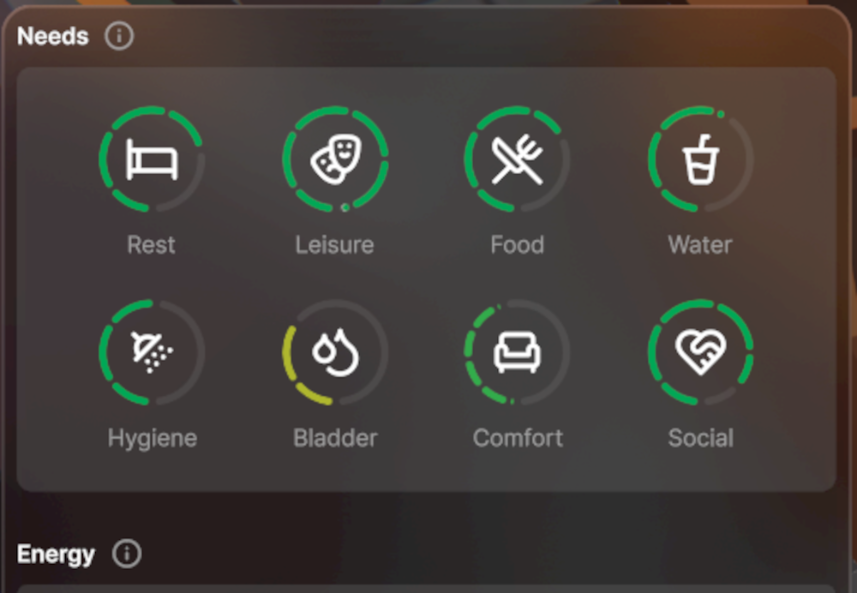
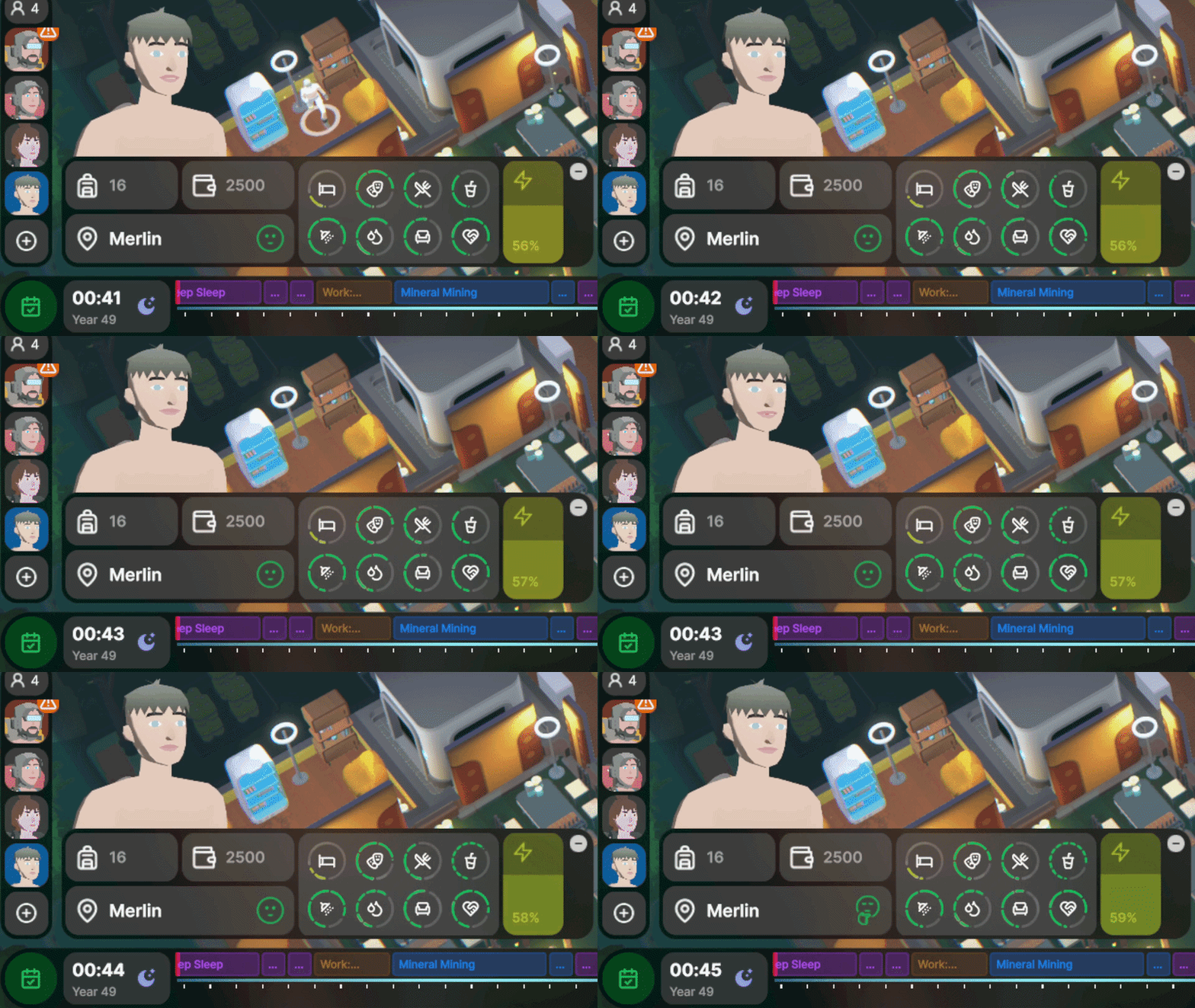
A Seedling tracks nine needs: rest, leisure, food, water, hygiene, bladder, comfort, social - shown as eight rings that fill and empty - and energy, which gets a bar of its own below them. The same set sits permanently on the bottom HUD, so you can read all nine at a glance without opening anything.
Only two of them can kill. The game's character data names food and water as the needs that cause death, and nothing else. Everything else on that list degrades, slows and demoralises: a Seedling with no social contact and filthy clothes is miserable and slow and will eventually stop doing what you asked, but it is not dying of it. A Seedling that has not eaten is.
Hold onto that, because it tells you what an emergency actually looks like. Hunger and thirst are the two you fix now. The other seven are the ones you fix with a schedule - and left alone they cost you the whole day rather than the Seedling.
Energy behaves unlike the rest, which is presumably why it sits apart. It recovers on its own over time, faster while your Seedling is sitting or lying down, and fastest when it is in a good mood. Since 0.3.3 a Seedling will also check whether it has the energy for a long activity before committing to it, which quietly prevents a class of early disaster.
Mood is not flavour text and it is not one number. It is a position on a grid, and the game shows you the grid.
Two axes, fifteen named states. Left to right runs from unpleasant to pleasant; bottom to top runs from low energy to high. So the bottom-left corner is Miserable, the top-left is Furious, the top-right is Ecstatic, the bottom-right is Blissful, and dead centre is Neutral. A Seedling that is Frustrated and one that is Sad are not two shades of unhappy - they are unhappy in different directions, and they need different things.
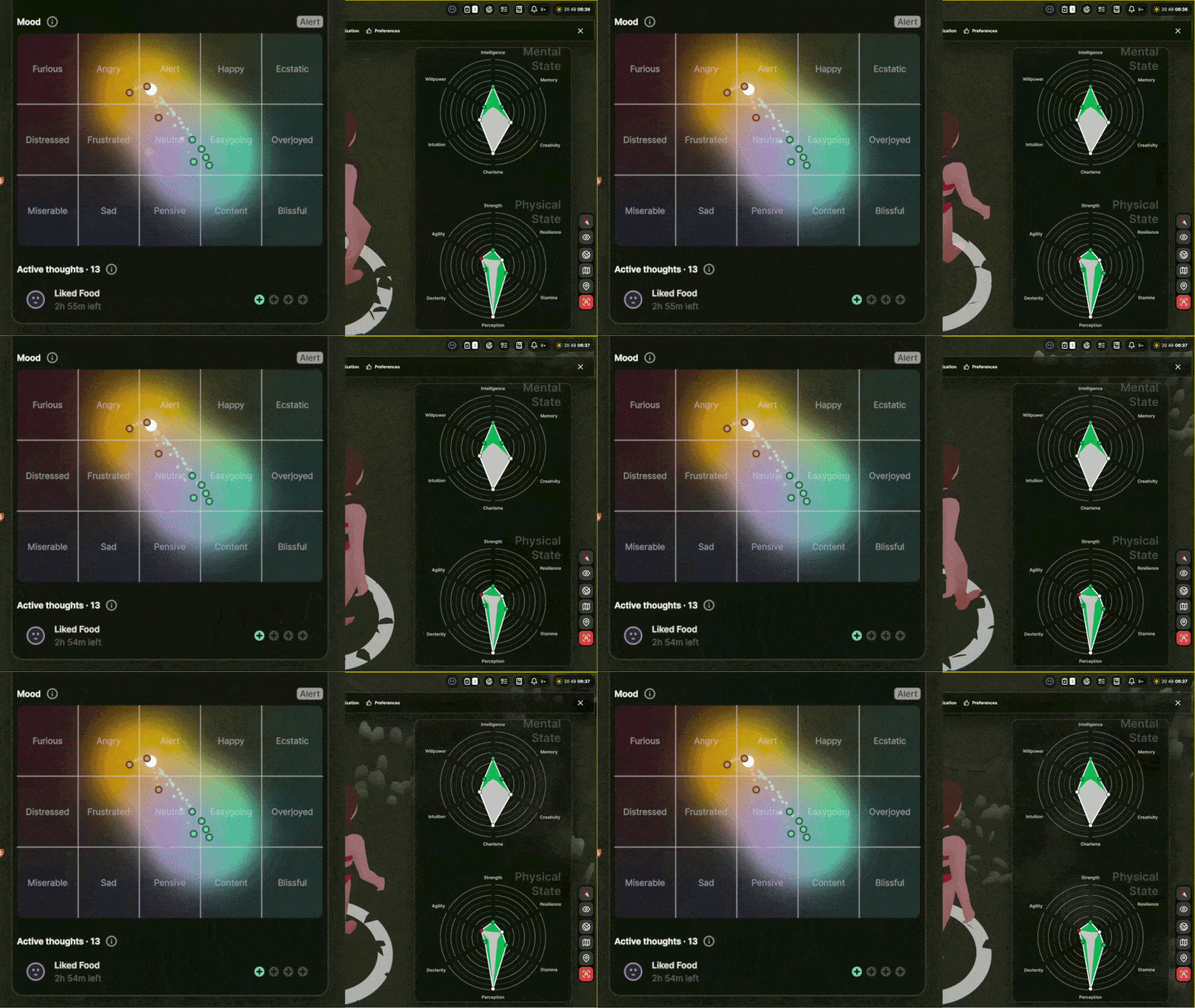
Underneath the grid sits the part that actually explains it: active thoughts. A Seedling carries a running list of them, each naming its cause and how strongly it is pulling. Filthy! - Hygiene, while unmet. Nauseating Room - 4h 28m left. Some persist until you fix the cause; others expire on a timer. Eighteen at once is an ordinary number.
This matters more than it sounds, because it turns mood from something you infer into something you read. When a Seedling is underperforming, you do not have to guess whether it is tired or lonely or standing in a room that smells. Open the panel and it is listed, with the cause attached.
One small kindness worth knowing: since the 3.2 content update, a newly landed Seedling starts happy, excited or hopeful. It used to be able to land frustrated or sad.
This is the part new players underestimate, and it is the reason a settlement thrives or stalls.
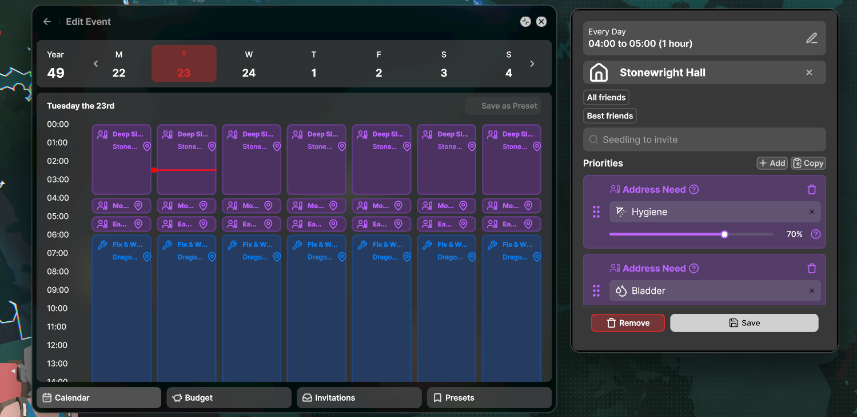
The Scheduler holds a list of activity priorities - up to twenty, a figure unchanged since the 0.3.0 notes. Alongside them sits Haul, which since 0.3.1 also covers self-pickup deliveries, and Client Deliveries for logistics employees. If you have read an older guide referring to a Deliver priority, that was removed in 0.3.1, and its entries were folded into Haul.
The trap is obvious once you have fallen into it: you fill all twenty slots because you can. A Seedling works down the ranking from the top and only reconsiders between tasks, so the bottom of a long list never comes up - and the bottom is usually where its own upkeep ended up. Left long enough, it degrades, and a Seedling whose stats or energy fall far enough stops following the schedule at all.
Start with four or five. Add one when you can name the thing it is displacing.
Three things in the Scheduler are worth finding on day one rather than week three:
This is a deep enough system to deserve its own guide, and one is coming - the Scheduler is the highest-leverage thing a new player can get right, and there is more to say about it than belongs here.
Jobs are advertised with services and reviewed by the people who use them, which means employment in SEED is a small economy rather than a menu.
For a first Seedling, take work that teaches you a production chain end to end rather than the best-paying thing available. Chains in SEED are long, and a chain missing one station does not run slowly - it stops. Learning where the stoppages are is worth more early than the wage. Getting fired is survivable, incidentally: since 0.3.3 it pays a full day's wage as severance.
Two mechanical mercies worth knowing while you learn. Failed crafts return all their input materials and critical failures return half, so experimenting with an unfamiliar recipe costs time rather than a stockpile. And the object catalogue - rebuilt in 0.3.2 - documents recipes, availability, placement, durability, repair and freshness, with a fullscreen crafting-chain explorer and filters by category and skill level. Most of what you would go to a wiki for is already in the client.
One naming trap while you learn your way around: 0.3.2 renamed Consumables to Foods, split into Raw, Meals and Drinks, and renamed Farming to Seeds. Older guides and videos will use the old names.
Everything above keeps running. Your Seedling works, eats, sleeps, talks to people, and makes decisions in your absence.
It helps to know the clock you are playing against: PAM's manual states that a year on Avesta is 24 in-game days. Seedlings age, and they die. A week away is nothing.
There is a deeper version of this worth knowing on day one. SEED has no NPCs at all - every Seedling belongs to a Cultivator. When someone leaves the game for good, their Seedling carries on without them, autonomous and still part of the world. The strangers your Seedling passes are other people's lives, running with or without the people who started them.
This is the most common reason new players bounce, and it is worth being blunt: if you need a game to pause when you leave, SEED will make you unhappy. If you like the idea of coming back to a character who has had a fortnight of their own, it is the whole point.
The practical version is that a session should end with your Seedling set up to survive the gap. Needs met, a Scheduler list that will not thrash, and something useful queued. What actually degrades while you are away, and how fast, is a big enough topic for its own guide.
Not everything available to you on day one deserves day-one attention.
What is worth your attention: the onboarding quest groups and PAM's in-game manual. They walk you through real objectives rather than a tooltip tour, and skipping them to work it out yourself costs a day you did not need to spend.
Also worth doing daily from the start: the Cultivator Level goals. They award experience toward your Cultivator track, which is the progression that outlives any individual Seedling.
The first hours are about not dying and not thrashing. After that, SEED becomes a game about supply - whether tomorrow can be paid for by what you set up today.
Resources on Avesta are finite in ways that catch settlements out, and governance becomes a real problem the moment a settlement is big enough to disagree with itself. Both are worth reading about before they become your problem.











SEED puts you in charge of people who make their own decisions, on a planet that keeps running whether or not you are logged in. One real hour is one day on Avesta. Here is what that actually means to play, what Early Access still gets wrong, and who should not buy it.
Read More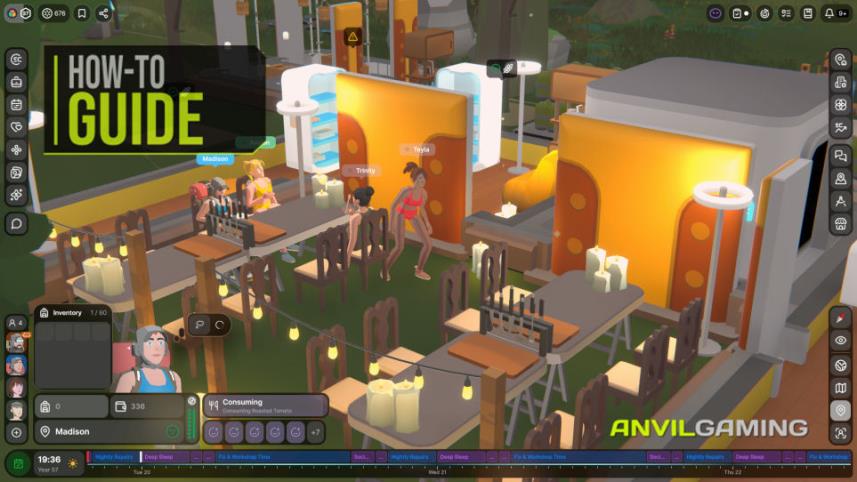
Your Seedling isn't lazy - it's following orders. Every event in SEED's Scheduler has its own priority list, and anything past the top few is wallpaper. How events work, why needs deserve their own hour, when a direct order beats the schedule, and a week you can copy.
Read More
A SEED hospital can have a skilled doctor, medicine on hand, and opening hours, yet still collect one-star 'wasted visit' reviews. This guide turns seven weeks of community troubleshooting into one current setup for services, staffing, stock access, and patient schedules.
Read More
Every crafting task in SEED shows three times, and most players read the wrong one. Total Time only says when the output appears - Work Time is what the job actually costs your settlement. Read them that way and the obvious recipe is often the expensive one.
Read More
Health in SEED is not a bar you refill. It is a system of specific conditions, severity tiers and sixteen medical specialisms — and the serious end of it depends on other people.
Read More
What a Seedling does while you are away in SEED — what keeps running, what it decides for itself, what degrades and how fast, and how to end a session so you come back to a life rather than a mess.
Read More
SEED's Dezima Donations event is coming to an end, but the story surrounding it may be far from finished. Spark posts have revealed an Axiom attack, a laboratory breach and DNA reaching Avesta's surface. Now, with a suspicious image showing animals and an unexpected reward teased, we investigate whether Klang has been quietly preparing the planet for new life.
Read More
Klang named its own broken system in public and came back three days later having fixed it four separate ways. The fix list is long enough to finally itemise what trade was costing people. The drone rebalance is the bill, and it charges only those who tidy up.
Read More
Klang says SEED market failures have fallen from roughly 20% to 4%, but that is not an all-clear. Buyers need free inbox space and scheduled haulers, while responsibility for a lost shipment can change at the Spaceport. Here is who carries the risk now.
Read More
SEED 0.3.4 takes rare ore out of repairs, teaches schedules to explain their failures and stops trees growing back. It also rebalances storage - and because the new capacities only apply to containers you move, tidying up is now the most expensive thing you can do.
Read More
Mundi hosted the Covital Show on SEED's official channel and put the roadmap on screen. 0.4 is City Life - law and order, electricity, organisations, building subdivision, bars. And the board says we are nowhere near the end of it.
Read More
SEED 0.3.3 caps a single Cultivator's votes at 15% of the society population, puts a price on firing a Seedling, and spends the rest of a very long changelog teaching the game to explain its own failures.
Read More
Wyrmhold does not run open recruitment. We take people for a need, after a conversation. This is what the Hold expects of a resident, what it provides in return, who it is honestly not for, and where to come and talk to us.
Read More
Wyrmhold is our society on Avesta. Its founding stories are not decoration - each one encodes a SEED system that will decide whether your own society survives. Here are three of them, and what they are really about.
Read More
The first record of what Wyrmhold actually did. One month, almost no visible expansion, and a great deal of infrastructure - the survey, the Kernel, the Dragonforge Ward workshops, the Elderwyrm department, an election, and the Hold's first registered business.
Read More