
GAMING
Loading






Before we put 915 Passivated Steel Sheets into SEED's new truck, we'd check the mine we thought was empty. Klang's 0.3.9 notes promise extra extraction cycles on existing underground tiles, including depleted ones. For a society short of materials, that's where we'd start.
The Mobile Transport Unit is the big new object, but the resource changes are the part we're most pleased to see. More life in existing deposits, a scanner that can concentrate on the ore you actually want, and a remaining-ore count instead of an abundance label should make mining easier to plan. Four new society policies will give leaders more economic levers, too. Those deserve a careful read before anyone touches the settings.
This is our pre-release assessment of Klang's 0.3.9 notes, dated 12 October 2026, alongside its 9 October resources blog. We haven't played this build.
Klang says the additional extraction cycles will be added on top of each tile's current state, whether it is untouched, partly depleted or fully depleted. We like that decision. Players who have already done the work of finding a useful deposit shouldn't have to start the search again just to benefit from the rebalance.
It won't be an equal refill. The amount added will depend on resource type and abundance: high-abundance rare tiles should receive a noticeable increase, while low-abundance rare tiles may receive very little or nothing. An exhausted deposit is worth checking; it isn't a guaranteed payday.
The reason is in Klang's resources blog. Rare materials are scarcer on the player market than the studio intended, so it plans to raise the resource budget per island, concentrating the rare-ore increase at higher abundance to avoid oversupplying easily found low-abundance tiles. We think that's a more sensible correction than making every discovery equally generous. A good find should still be a good find.
The extractor tooltip will also show the number of ores remaining rather than the abundance level. That's the number we'd want beside a machine: how much is left before we have to think about moving it.
We wouldn't confuse longer-lived deposits with faster production. Klang's blog says it hasn't found a satisfactory way to combine still higher output with shorter machine processing without disrupting other systems. The patch's extraction-time fix is a correction to the display, not an announced speed increase. A mine lasting longer is good news. It doesn't make the machine work faster.
The radar filter will let you select resource types and ignore the rest. If we're looking for Aurite Ore and Argentite Ore, we won't have to spend detection attempts on Hematite Ore; Klang says that should improve the average rate of finding the resources we've chosen. We welcome the distinction between finding something and finding something useful.
A radar session will run three times longer while probing three times less often. We wouldn't read that as a promise of more probes or a guaranteed rare discovery. The useful change is the filter, not the bigger number on the timer.
Two smaller fixes should make scanning less irritating. A scan that fails without finding anything because of the reported bug will no longer consume its power cell or start the cooldown, and the scanner panel will keep showing an inventory-held scanner and its timers when a scan ends. Klang is right to fix the interface as well as the resource balance. Paying a power cell to discover a broken button is a poor exploration loop.
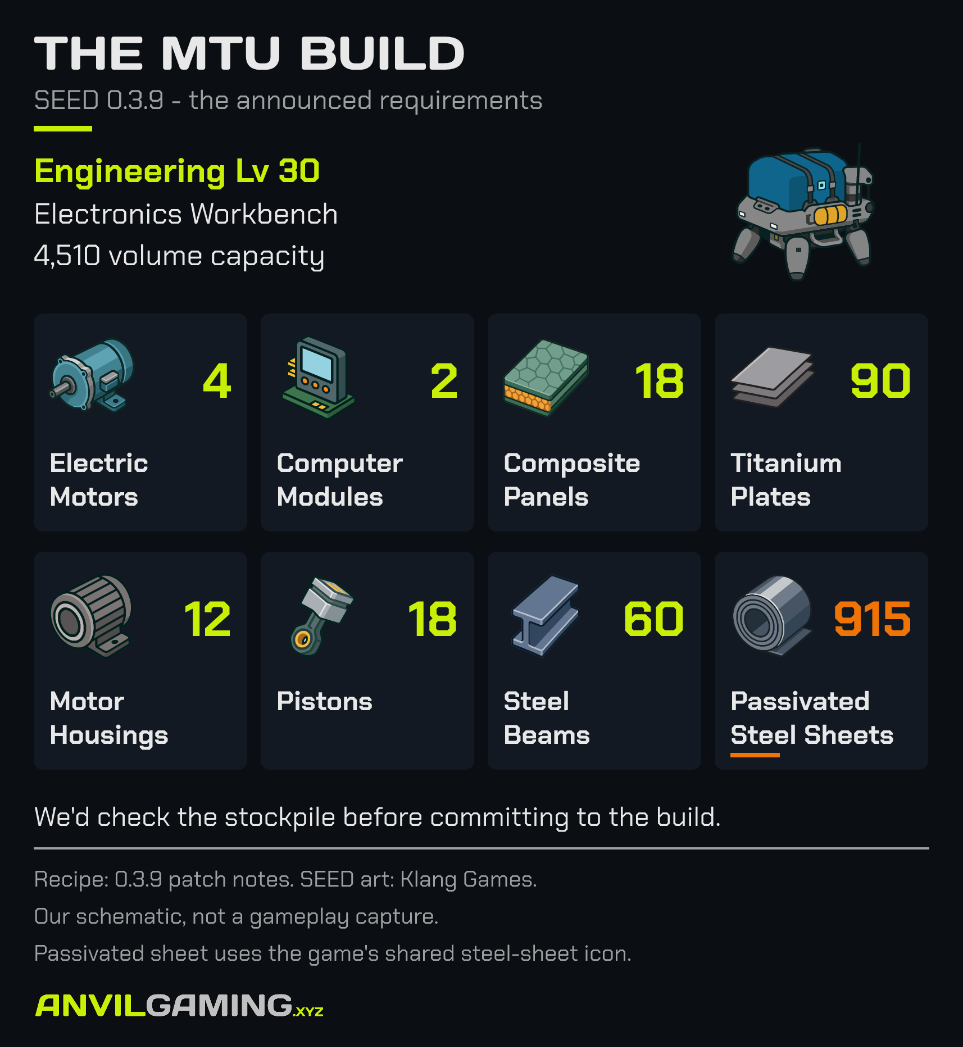
Klang's Mobile Transport Unit will have a volume capacity of 4,510 and will be crafted at the Electronics Workbench with Engineering Lv 30.
The studio describes it as a large, slow-moving exploration vehicle, moved manually through the direct-control menu's "Move to" command, and warns that it won't always path around obstacles.
We'd plan its route before loading it, rather than expect a truck-sized object to improvise between the trees.
Here's the full bill in the notes.
We'd check every part of it before committing a society's stockpile:
The new Passivated Sheet recipe will require 5 Nitric Acid and 1 Steel Sheet, with 10 Waste Water as a by-product. We'd treat the chemical supply and the waste as part of the build, not something to discover after promising everyone a vehicle. The notes don't give the sheet recipe's output quantity, so we aren't multiplying those inputs into a supposed full MTU production bill.
Access and movement will be separate permissions: Vehicle Access for Seedling access, primarily hauling, and Vehicle Move for a player to issue a move command. It will also have resource-provisioning settings like other containers. We'd decide who can load it and who can relocate it before giving out permissions. Those are different responsibilities, especially when the cargo belongs to more than one person.
We'd be even more careful about where it is packed. The packed pile will belong to the location's owner, and unpacking will make the MTU belong to the location's owner too. If its owner is gone or dies, the notes say it will go to whoever owns the location where it stands. Parking isn't merely tidying up here; the location can decide ownership.
There's a parking rule as well. When the MTU is outside a building or plot owned by its owner, its menu will show a countdown; after 30 real minutes, any Seedling will be able to shove it 5m away. We don't need to guess what Klang means by time on that one. This is an expensive vehicle with a very public tow service.
Our recommendation is to build for an identified hauling job, not simply because the MTU is new. If we're repeatedly leaving useful material behind because we can't carry it home, the capacity has a purpose. If we haven't found the material yet, we'd sort the scanner and the deposits first.
Debris will appear on the map and can be harvested for Scrap Metal; the resources blog says these objects will continuously respawn. Scrap will be bulky, which is why Klang recommends the MTU for gathering it. We can see the intended loop: go out, collect a large load and bring it back for recycling.
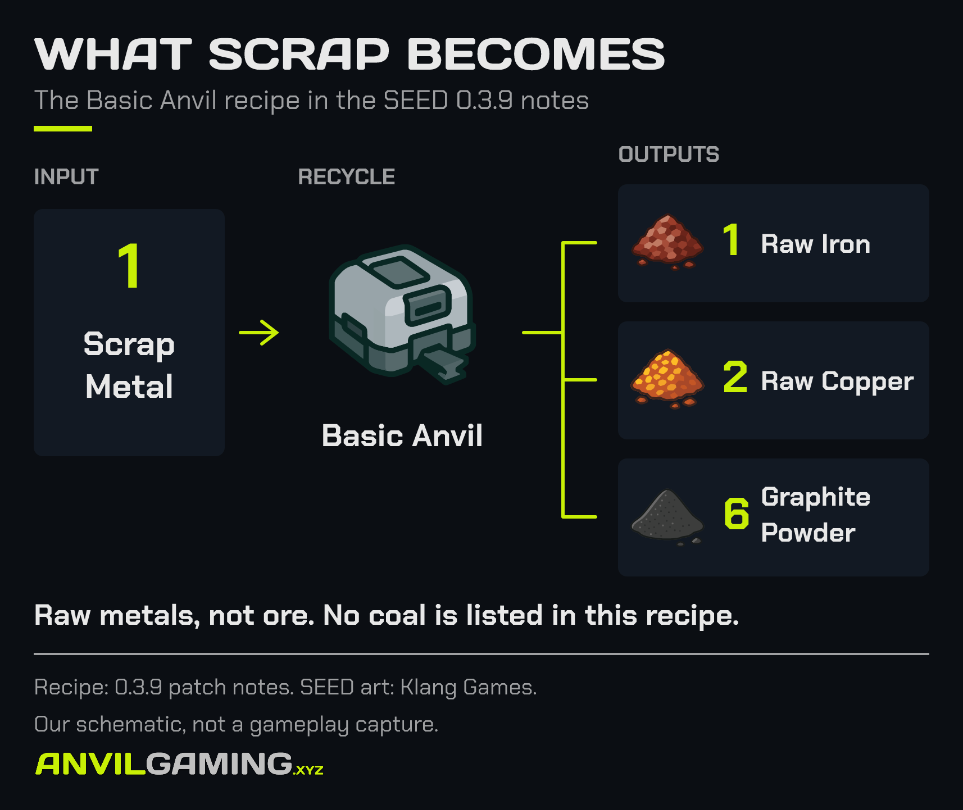
The patch notes give a specific Basic Anvil recipe: 1 Scrap Metal will yield 1 Raw Iron, 2 Raw Copper and 6 Graphite Powder. We'd use that later recipe when planning. The 9 October blog described Chalcopyrite Ore and Hematite Ore instead of raw metals, so the two documents don't agree on the output stage. Ore and raw metal aren't interchangeable names, and we won't quietly treat them as though they are.
Klang is also frank about the initial balance: it is deliberately aiming for scrap output that may feel too low rather than too high, to avoid suddenly oversaturating the market. We'd take that warning seriously before building a vehicle solely to sell its cargo.
The blog talks about easing coal and copper shortages, but the listed recycling recipe contains no coal. We wouldn't promise a direct coal supply from Scrap Metal. Nor do these notes establish how much scrap a Debris object gives, how long it takes to return, or what a collection run will earn. The truck has a capacity. It doesn't come with a business forecast.
The society policies will add Export Tax, Business Tax, Land Tax and Minimum Wage. We'd welcome the ability to make more deliberate choices about how a society pays for itself, provided members know what those choices will cost them.
Export Tax will take a share from the seller when goods are sold to another society. We'd check it before quoting an export deal; a sale's headline value won't tell a seller what they keep.
Business Tax will take a monthly share of each business's balance. The word we'd underline is balance. Klang hasn't described a tax on profit, so we'd review cash held for inputs and wages as well as money available to distribute. A wallet can be full because a bill is coming.
Land Tax will be a monthly charge per plot tile above a free allowance. We'd want to see the allowance and the actual rate before deciding how much spare land to hold. The notes don't give either figure.
Minimum Wage will require an employer to pay the difference when a wage falls below the minimum. We'd review the wage bill before setting it, rather than assume the policy will fund itself. Klang doesn't give the minimum's value or explain every payment edge case in these notes.
None of this is enough to recommend a tax rate. We'd use the new controls to answer an actual society budget problem, explain who pays, and check the implementation before making promises about revenue.
The Access role is a useful companion change. It will let a Seedling have workplace access, including private rooms, without being given a job. We'd use it when access is the need. Employment shouldn't have to be a makeshift key.
Player-chosen heirs appear in the 0.3.9 highlights, but Klang already described that system in its 0.3.8 notes, and we covered it in the previous instalment. We wouldn't count the same announcement as a new feature twice.
The concrete inheritance change in these notes will send a dead Seedling's inventory and equipment to Cultivator Inventory instead of Orbital Storage, alongside clearer buttons and inventory information in the Last Will window. We like the simpler destination. Death is already enough administration without putting someone's belongings somewhere awkward to reach.
We wouldn't assume an heir choice also settles the MTU. The vehicle section gives it a location-based ownership rule, and these notes don't explain how that interacts with estates. Until that is clear, where a vehicle stands deserves as much attention as who is meant to inherit.
The market will stop presenting the unfillable remainder of partly filled Buy Now orders as demand or using it in suggested sell prices. We think that's one of the most useful fixes in the patch. A seller needs a market signal they can act on, not an invitation to supply an order nobody can fill.
Buy Now totals will include society VAT, buy-order creation will show the wallet hold including VAT, and unused funds will return to the wallet. The notes also promise the full ordered quantity when the wallet covers the displayed total, correct totals for several same-resource contracts, and an "Inbox full" status when restocking has stopped for lack of capacity. We'd check those figures and statuses before blaming a quiet production chain on low demand.
On the workshop floor, Quick Produce will be disabled while a machine is busy instead of replacing its current task; idle Produce schedules will say when a machine has no task set; and blocked machines will show a warning telling us an object is in the way. We'd rather be told the reason than keep issuing the same instruction more firmly.
Builders should get relief too: Klang lists fixes for construction stuck at 98% or 25% after the final materials arrive, valid doors disappearing during edits, and overlapping furniture unnecessarily blocking building changes. We also welcome the sapling fixes: blocked mature saplings should remain visible, and blocked ones should no longer hold up the rest of the world's planted trees.
For households, pregnancy will take 30 hours instead of 10. We wouldn't convert that into a real-world due date: the line doesn't specify whose hours. The notes also address infants growing up twice and Seedlings failing to reach their next life stage. For clinics, Medical Herbal Tea will become Herbal Ointment without changing its recipe or effects, and the heal-service stock warning will name the missing remedies. We'd check labels and stock lists before treating either as a new treatment.
Seed Companion will add a Seedling inventory view, chat will gain message reporting in the main window rather than the mini-chat widget, and the bug reporter will list known issues that players can upvote or add detail to. We like improvements that make a problem easier to see or report. They don't need a vehicle-sized headline to be useful.
Our first jobs would follow the problem, not the order of the patch notes:
We're pleased with Klang's plan to put more material into the deposits players have already found and give them better information about what remains. That's a useful correction with a practical first step. The MTU can wait until we've got something worth putting in it.



















Klang put a date on SEED's first old-age deaths: Halloween. We did the sums on the game's own warning, then tracked three episodes of promises: warehouse shelves still coming, a waste compactor teased, an ore blog delivered and Seed Industries' slow goodbye.
Read More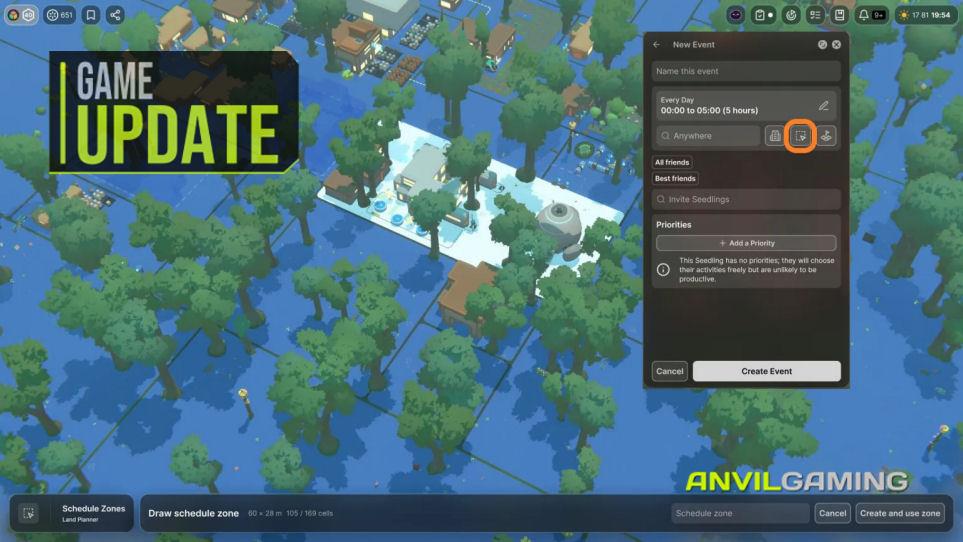
SEED 0.3.8 lets you draw a zone and send a Seedling to clear it, ends the storage grace period without losing anyone's goods, and lets you choose who inherits when a Seedling dies. We checked it against Klang's own top five problems. Four got real work. The fifth got Monkey Bars.
Read More
Klang's One World show was a party: island dance crews, a live poll, a PAM cameo. Between numbers, an engineer explained why drones get stuck, how a 520-shelf plot can make an island lag, and how close the MTU is. Our take: give your Seedlings a road and your duck a corridor.
Read More
Last week storage topped SEED's wish list. This week Klang put a shelf on screen, art done and code under way, expected within a fortnight. Our one-week scorecard: the refunds landed, the bug list didn't come back, and the griefing response is still owed. Plus the herds and 0.4.
Read More
SEED 0.3.7 puts wild Anima Herds on Avesta, and Klang's own lore traces them to the Dezima breach the donation event was built around. Returning players also get two real hours to answer a Seedling instead of ten minutes, and big trees can finally leave big seeds.
Read More
Klang's new Wednesday show opened with SEED's 25 worst bugs, ranked and explained how the ranking is made. By our count, market faults carry two-fifths of the pain, while storage dominates what players ask for. What was promised, what was not, and how to push a bug up.
Read More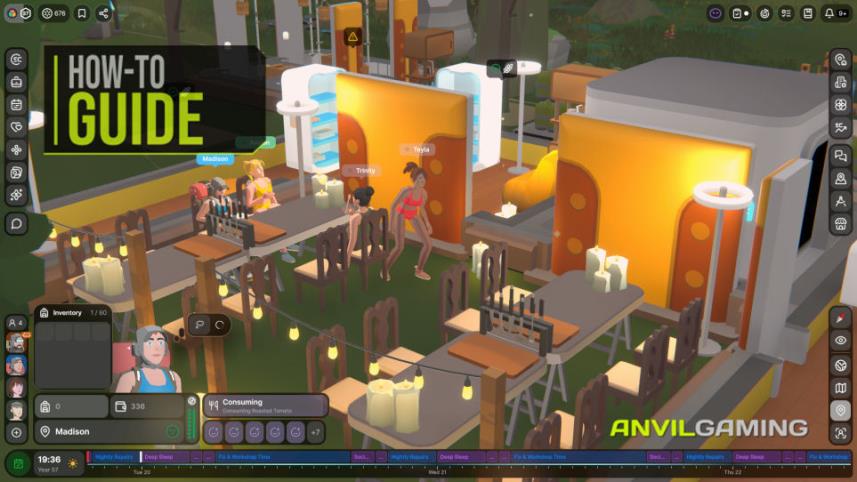
Your Seedling isn't lazy - it's following orders. Every event in SEED's Scheduler has its own priority list, and anything past the top few is wallpaper. How events work, why needs deserve their own hour, when a direct order beats the schedule, and a week you can copy.
Read More
A SEED hospital can have a skilled doctor, medicine on hand, and opening hours, yet still collect one-star 'wasted visit' reviews. This guide turns seven weeks of community troubleshooting into one current setup for services, staffing, stock access, and patient schedules.
Read More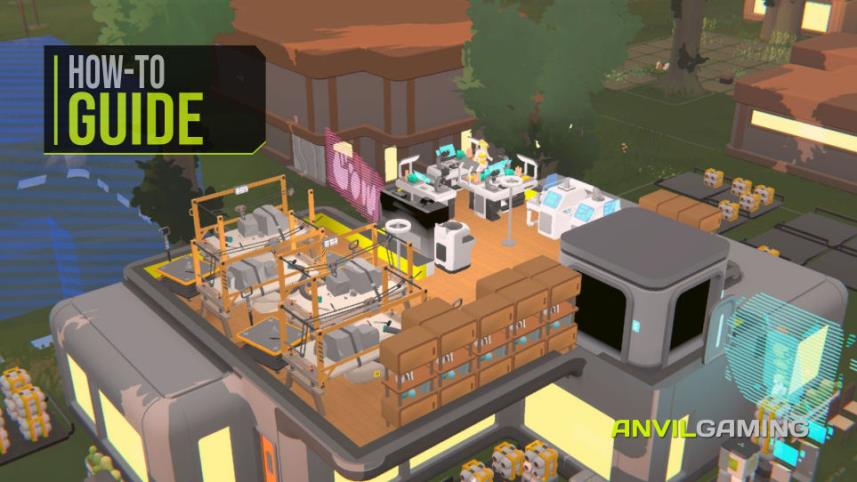
Every crafting task in SEED shows three times, and most players read the wrong one. Total Time only says when the output appears - Work Time is what the job actually costs your settlement. Read them that way and the obvious recipe is often the expensive one.
Read More
Health in SEED is not a bar you refill. It is a system of specific conditions, severity tiers and sixteen medical specialisms — and the serious end of it depends on other people.
Read More
What a Seedling does while you are away in SEED — what keeps running, what it decides for itself, what degrades and how fast, and how to end a session so you come back to a life rather than a mess.
Read More
SEED puts you in charge of people who make their own decisions, on a planet that keeps running whether or not you are logged in. One real hour is one day on Avesta. Here is what that actually means to play, what Early Access still gets wrong, and who should not buy it.
Read More
Wyrmhold does not run open recruitment. We take people for a need, after a conversation. This is what the Hold expects of a resident, what it provides in return, who it is honestly not for, and where to come and talk to us.
Read More
Wyrmhold is our society on Avesta. Its founding stories are not decoration - each one encodes a SEED system that will decide whether your own society survives. Here are three of them, and what they are really about.
Read More
The first record of what Wyrmhold actually did. One month, almost no visible expansion, and a great deal of infrastructure - the survey, the Kernel, the Dragonforge Ward workshops, the Elderwyrm department, an election, and the Hold's first registered business.
Read More