
GAMING
Loading





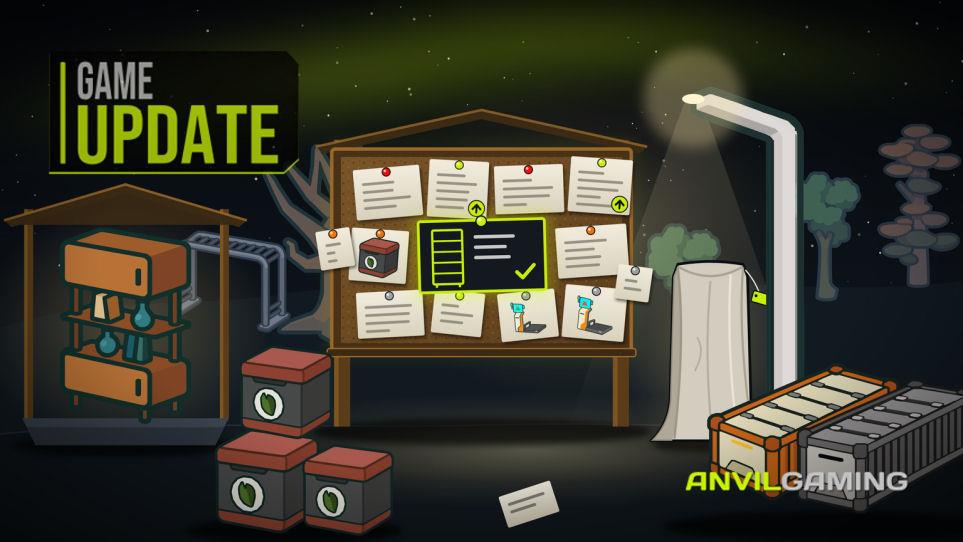
Last week, storage topped SEED's wish list. This week, Klang put a shelf on screen.
That was the moment that mattered in Episode 2 of The Notice Board, Klang's weekly community show with Andy, its community manager, and JJ, its publishing lead, which aired on Wednesday 30 September. The shelf is a vertical storage unit of the kind players have been asking for since the storage rebalance. Its art is made, it is being coded, and it is expected next week or the week after.
The short version of the rest: next Tuesday's patch may change who can take what from a building, and should show you more about a society before you join it. 0.4, which Klang called one of its biggest patches yet, sits very close to Halloween. The new Anima Herds do very little for now. And Klang says it has fixed 639 bugs since Early Access began. What it did not do was put the bug list back on screen, or publish the griefing response it promised last week. We said we would keep score, so we have.
This write-up is based on the Episode 2 broadcast of 30 September 2026, checked against our Episode 1 coverage and Klang's 0.3.7 notes. Klang's plans and statements are reported as Klang made them. The grading, the scorecard and the opinions are ours. Nothing here is a hands-on test.
The last suggestion on this week's list asked for a vertical storage solution. Klang answered it with pictures.
Andy said he has spent the past few weeks working with Klang's design and art teams on it, ever since players pushed back on the storage changes, and that he pushed it through internally himself. The art is done. It is being coded and put into the game. Whether that is next week or the week after, he would not promise, and he will confirm on Discord. His message to everyone who asked for it: "You got what you asked for."
On our reading, this answers the third request on Episode 1's list - a compact, stackable indoor container to replace the nerfed fancy shelves - which Andy said a week ago he was looking into personally. It is the first suggestion we have tracked that went from a promise to a picture, and that is exactly what this show is for.
What nobody said is how much it holds or what it takes to build. Do not plan a warehouse around it yet.
One instruction did come with it: put shelves indoors. They are not meant for outdoor storage, and left outside they may decay. Given what the rest of this episode said about how quickly Avesta wears furniture out, take that one seriously.
The same suggestion had a second half: let players salvage items they no longer want for their resources. Klang said that is in process, with several approaches being weighed and no date. Andy added that he plays too, and is as fed up as anyone that he cannot delete or scrap things. A week ago, Klang described trash and waste handling as in active development. This week, salvage is in process. Same news, firmer handshake.
There is a timing catch. As our 0.3.4 and 0.3.5 pieces set out, the new storage capacities apply to every container from the 6 October patch, when the grace period on old ones ends. A shelf due next week or the week after could land on either side of that. Last week we offered a test for the next storage change, and its first question was whether the alternative is already in the game. Strictly, 6 October is not a new nerf - it is the old one finishing - but if the shelf arrives a week after the squeeze, the answer on the day will be no. Plan your storage around the capacities, and treat the shelf as a bonus if it turns up in time.
Two changes are heading for next Tuesday's patch, with the hosts' own hedges attached.
The first came from a suggestion that employees should lose pickup access when their shift ends, so off-shift staff stop eating the work stock. Klang said changes to how people access buildings, and the items inside them, are coming, potentially in next week's patch. Staff raiding the stockroom after clocking off is the most relatable thing a Seedling has done all month, and it is about to get harder.
The second is more information about a society before you enter it, such as who is actually active. That follows a week in which some players joined societies that turned out to be inactive, and others went looting in cities they believed were dead. More on that below.
Neither is quite what Episode 1's list asked for - employee lockers, and a "last seen" indicator for society leaders - but both go at the same problems from the other side. Klang said the notes should come out before the release, and hopefully not at midnight. If your business feeds its staff from its own stock, read them.

We said last week we would track what moved. Here is where everything Episode 1 put on the record stands, one episode later.
Klang also said several server-stability fixes went out this week, with more to come, and that the studio has fixed 639 bugs since Early Access began on 21 July. That is about nine a day, weekends included. That is an impressive pace. It is still no substitute for seeing the list.
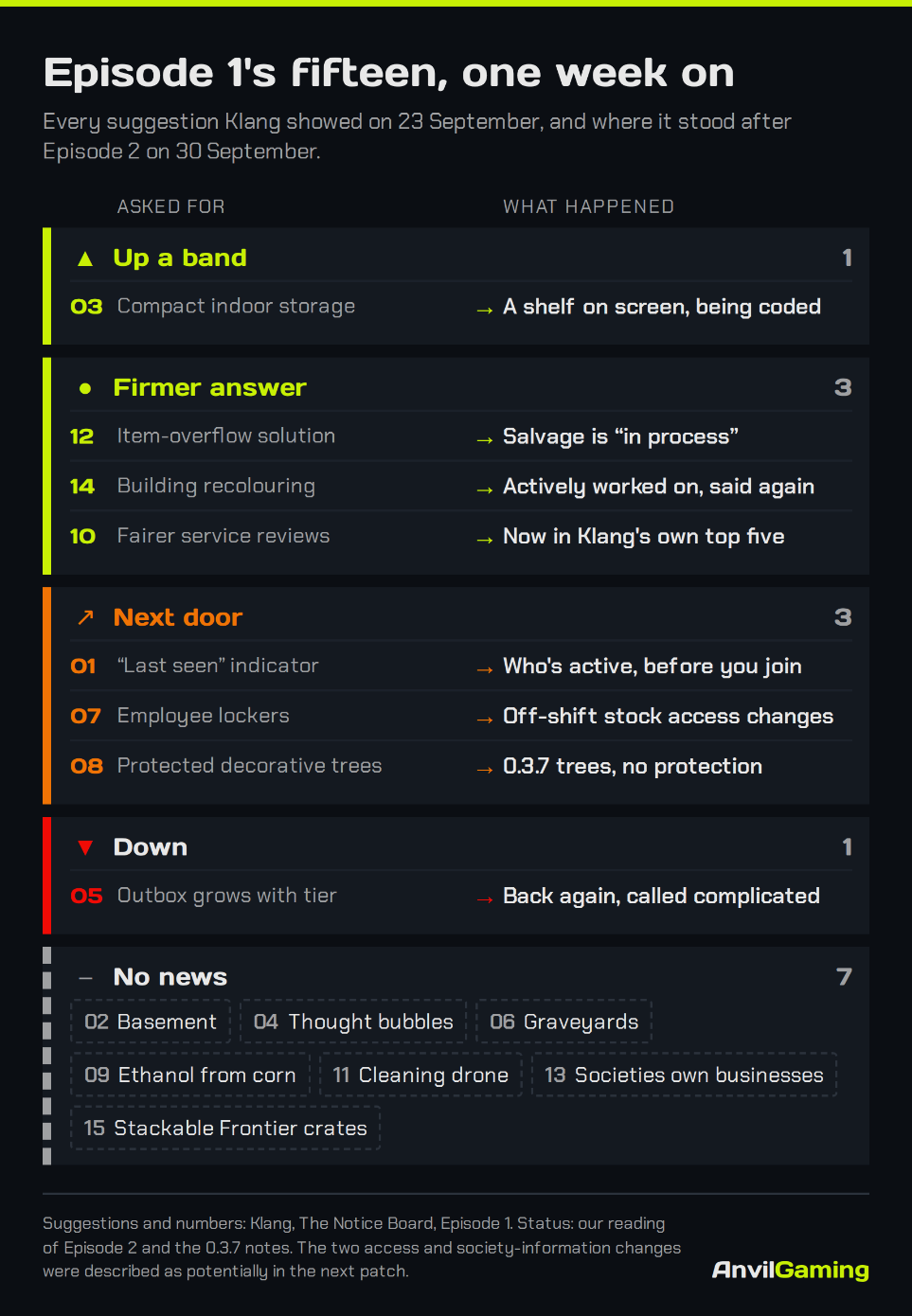
Then the fifteen suggestions. One moved up a band, three got firmer answers, three got something next door to what was asked for, one went down, and seven got no news at all.
The survey moved too. Episode 1 talked through eight themes from Klang's exit survey. Episode 2 showed a ranked top five. The first three are the same, in the same order: performance and stability, Seedlings not doing what they are told, and onboarding. Two are new: paid orders that never arrive alongside hotels and clinics rated low for no clear reason, and upkeep and decay outrunning progress. Storage, griefing, tedious manual work, broken production lines and vital needs all fell out of the top five. Five is a shorter list than eight, so falling out of it is not the same as being fixed.
Last week we said this show would be at its best when it marked what had moved. This week it did that once, with a shelf, and it was the best moment of the episode.
Avesta got its first animals in 0.3.7, and the chat wasted no time. The first question was what the Anima Herds do. The second was whether you can eat one.
Klang's answer to the first: not much, at the moment, and they are something the studio is looking at for the future. On the second: no promises. The story Klang told for them fits the 0.3.7 lore - faults on the Dezima station let DNA get released to the surface, and there may be more where that came from. That still does not make the herds the "unexpected reward" from the Dezima Donations event, which Klang has never said. But it is one more line tying them to the station our Dezima piece was watching.
It also answers the first open question in our 0.3.7 analysis: what the herds are for. For now, they are for looking at. And they are not behind your lag. Asked directly, Klang said the herds have not affected server performance.
0.3.7 stretched the time a returning player gets to react before a Seedling decides something on its own, from about ten real minutes to about two real hours. It drew enough questions that Klang opened the show with it.
The window is not the trigger. Autonomous behaviour still only starts after a player has been away for several days. An employed Seedling should not leave its job on its own at all, and for the second week running Klang said that if yours does, it is a bug to report. The case the change is really for is an unemployed Seedling whose Cultivator has been gone for days: it now gives you a few hours before it goes off to find work. Klang said it is still discussing the right length internally, so treat the figure as provisional.
The reason the behaviour exists is fair. Players join a society, never come back, and leave a Seedling eating the society's food and drinking its water while contributing nothing. Letting that Seedling look for paid work, the way a real person would, fixes the society's problem. Our log-off guide covers what else a Seedling does while you are away.
The wage trick some societies were worried about - offer a job at a high wage, cut it to zero, then go quiet - should not work on a Seedling that already has a job, Klang said. It will look at telling players clearly when their wage changes, which is the better fix anyway.

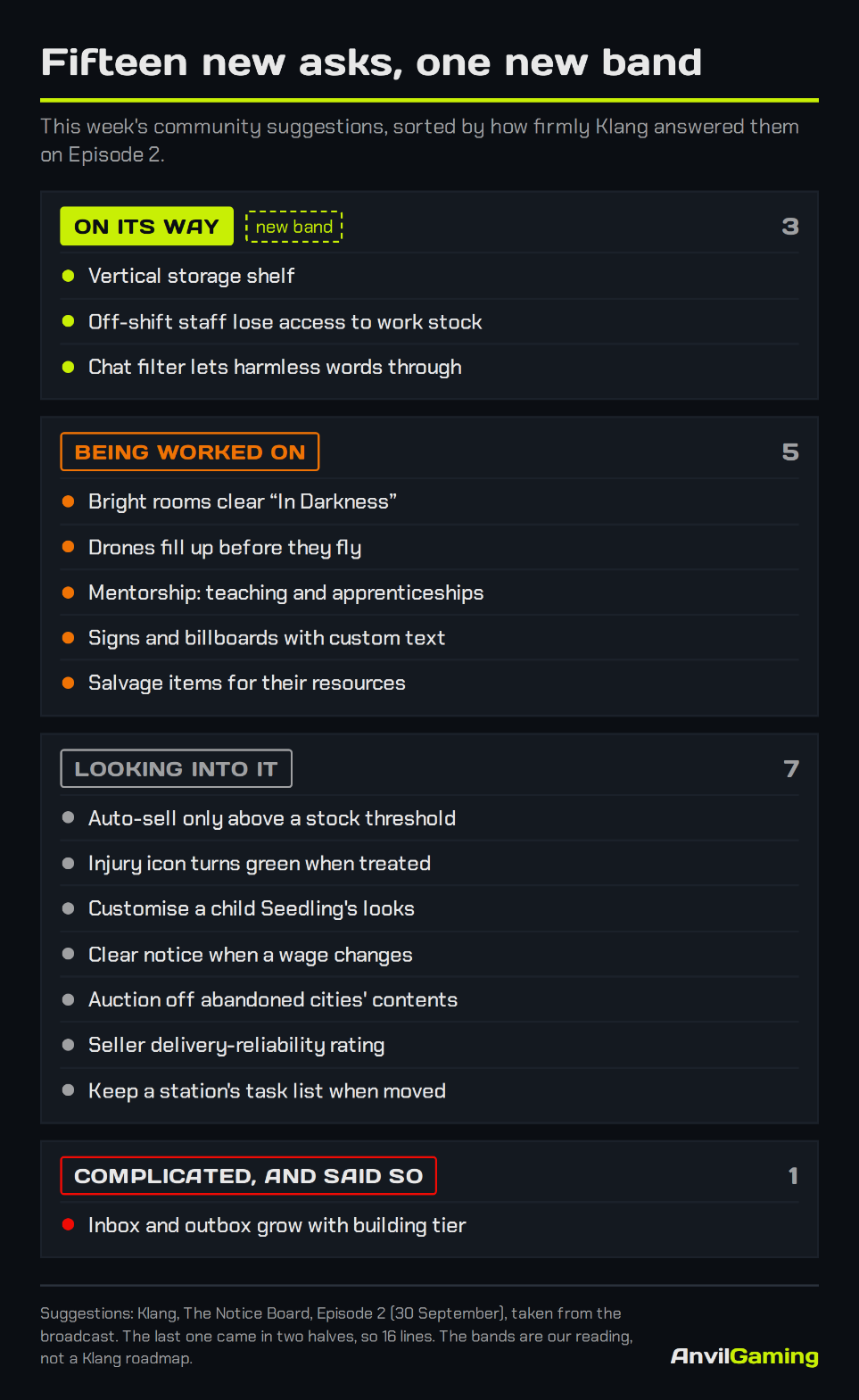
Klang now goes through suggestions week by week, taking only the last seven days, so this is a fresh list rather than last week's revisited. The hosts were clear that a brand-new suggestion rarely gets a firm answer in its first week, and that everything read out goes to the engineers. As before, the grading is our reading of how firmly each one was answered, not a roadmap. This week we needed a new band at the top.
On its way
Being worked on
Looking into it
Complicated, and said so
That is three on their way, five being worked on, seven being looked at and one called complicated, from fifteen suggestions with the last one in two halves. Last week, no suggestion got a date. This week, a shelf expected within a fortnight and an access change pencilled in for next Tuesday are the closest this show has come to a calendar.

A viewer asked whether officials abusing their power is part of the design - something a society deals with by pressuring the mayor or voting them out - or something Klang means to protect against. The answer was both. SEED is designed for societies to manage and police themselves, the hosts said, but Klang accepts the protections for societies, their leaders and their members are thin in places, and it is building more. Some of the loopholes, they added, would make great content if they were turned into a proper loop.
This is the right direction, and it is the same principle Andy set out last week: drama is fine, drama you cannot respond to is not. But last week Klang said it would publish its approach for the societies affected, and a week of good intentions is not that. We will count it delivered when it is written down.
Klang's user research team builds a list from the survey you get when you quit the game - the one with the smiley faces - plus bug reports and every Discord channel, not just the suggestions channel. It is updated weekly and presented at the studio's Monday morning meeting. This week's top five, in Klang's order:
That last one got the most honest answer of the night. One host said that when he logs in after a few days all his beds are broken, and joked that SEED's shelves must be flat-pack. He has a point, and the clock makes it worse. If a real day is a year on Avesta, a bed that gives out after three real days has, strictly, served three years. That is still a bed nobody would buy twice.
The survey had good news too, and Klang shared it. Enthusiasm is holding up. Players describe systems finally clicking and the learning curve flattening, which the hosts partly credited to players explaining the game to each other. And people are looking forward to the next patch rather than back at problems.
Friday's Covital Show, on 2 October, is a celebration of Avesta and its community, and Klang wants clips for it: about 15 seconds of your society, with your own voice-over finishing the sentence "SEED is...". The hosts would also like society leaders to come on a future Notice Board and share their screen, so the team can see what is going wrong rather than read about it.
The community section closed with thanks to the players who answered the most questions in Discord over the week, and to streamers making content for newcomers. One of the names thanked for support was our very own DancingCoder. We will leave the praise to Klang.
Episode 1 was a show about promises. Episode 2 brought one back as a shelf - art made, code under way, a fortnight's window - and pencilled an access change in for next Tuesday. That is the show doing its job: the loudest wish from one Wednesday, answered with pictures the next. Klang deserves full credit for that, and for the refunds that landed the morning after the first episode.
Two things are still missing. The Top 25 has not been back on screen, so nobody outside the studio can see which of SEED's worst bugs have gone. And the griefing approach Klang said it would publish is still a set of intentions. Either could be fixed in a single episode.
We will keep the scorecard going. Episode 3 is expected next Wednesday, and the first thing we will check is whether the shelf beat the storage deadline.

















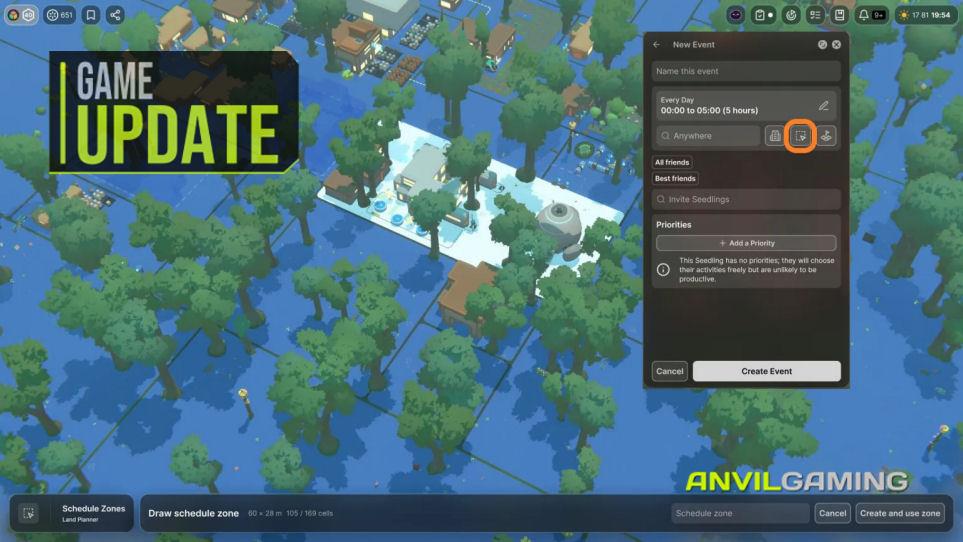
SEED 0.3.8 lets you draw a zone and send a Seedling to clear it, ends the storage grace period without losing anyone's goods, and lets you choose who inherits when a Seedling dies. We checked it against Klang's own top five problems. Four got real work. The fifth got Monkey Bars.
Read More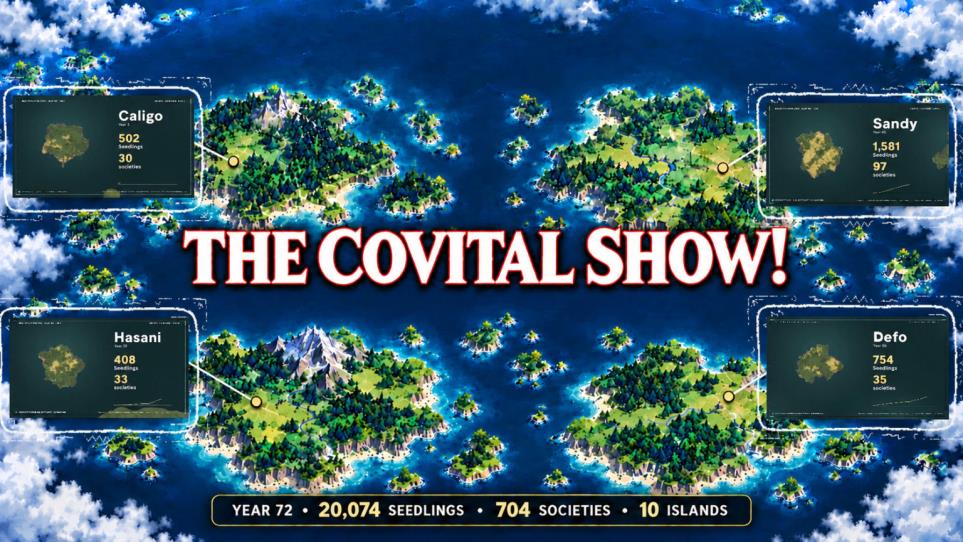
Klang's One World show was a party: island dance crews, a live poll, a PAM cameo. Between numbers, an engineer explained why drones get stuck, how a 520-shelf plot can make an island lag, and how close the MTU is. Our take: give your Seedlings a road and your duck a corridor.
Read More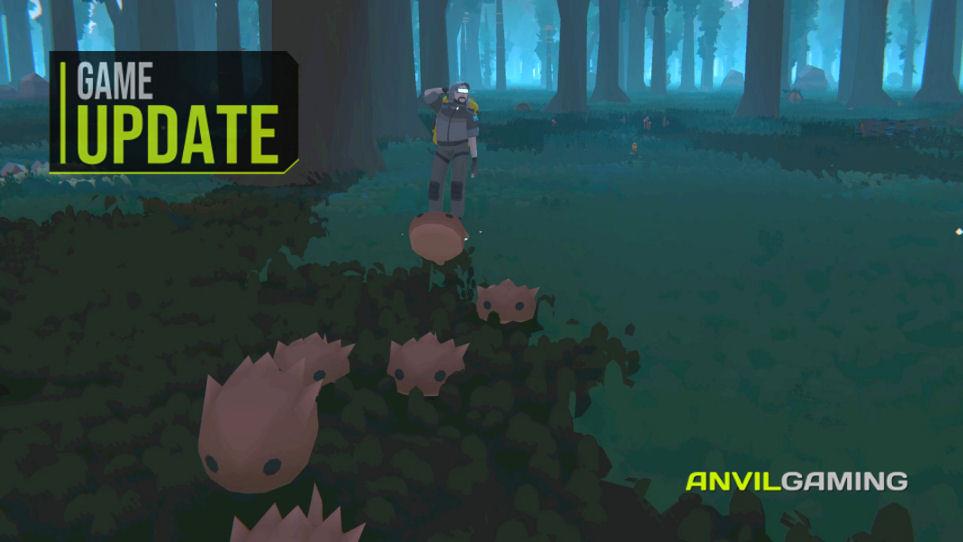
SEED 0.3.7 puts wild Anima Herds on Avesta, and Klang's own lore traces them to the Dezima breach the donation event was built around. Returning players also get two real hours to answer a Seedling instead of ten minutes, and big trees can finally leave big seeds.
Read More
Klang's new Wednesday show opened with SEED's 25 worst bugs, ranked and explained how the ranking is made. By our count, market faults carry two-fifths of the pain, while storage dominates what players ask for. What was promised, what was not, and how to push a bug up.
Read More
Forty building attachments existed in SEED with no recipe to make them, and twenty-three more required rare ore. One patch fixes both. Underground water refills itself now, unless you stack pumps on it. The cheapest thing in this update is caring how your settlement looks.
Read More
SEED's Dezima Donations event is coming to an end, but the story surrounding it may be far from finished. Spark posts have revealed an Axiom attack, a laboratory breach and DNA reaching Avesta's surface. Now, with a suspicious image showing animals and an unexpected reward teased, we investigate whether Klang has been quietly preparing the planet for new life.
Read More
Your Seedling isn't lazy - it's following orders. Every event in SEED's Scheduler has its own priority list, and anything past the top few is wallpaper. How events work, why needs deserve their own hour, when a direct order beats the schedule, and a week you can copy.
Read More
A SEED hospital can have a skilled doctor, medicine on hand, and opening hours, yet still collect one-star 'wasted visit' reviews. This guide turns seven weeks of community troubleshooting into one current setup for services, staffing, stock access, and patient schedules.
Read More
Every crafting task in SEED shows three times, and most players read the wrong one. Total Time only says when the output appears - Work Time is what the job actually costs your settlement. Read them that way and the obvious recipe is often the expensive one.
Read More
Health in SEED is not a bar you refill. It is a system of specific conditions, severity tiers and sixteen medical specialisms — and the serious end of it depends on other people.
Read More
What a Seedling does while you are away in SEED — what keeps running, what it decides for itself, what degrades and how fast, and how to end a session so you come back to a life rather than a mess.
Read More
SEED puts you in charge of people who make their own decisions, on a planet that keeps running whether or not you are logged in. One real hour is one day on Avesta. Here is what that actually means to play, what Early Access still gets wrong, and who should not buy it.
Read More
Wyrmhold does not run open recruitment. We take people for a need, after a conversation. This is what the Hold expects of a resident, what it provides in return, who it is honestly not for, and where to come and talk to us.
Read More
Wyrmhold is our society on Avesta. Its founding stories are not decoration - each one encodes a SEED system that will decide whether your own society survives. Here are three of them, and what they are really about.
Read More
The first record of what Wyrmhold actually did. One month, almost no visible expansion, and a great deal of infrastructure - the survey, the Kernel, the Dragonforge Ward workshops, the Elderwyrm department, an election, and the Hold's first registered business.
Read More