
GAMING
Loading





Three days ago, Klang said a large set of market fixes was coming in 0.3.5 and would not say what was in it. Studios say that sort of thing constantly. This one came back seventy-two hours later with seventeen fixes in the market and trade section alone, four of them aimed at Auto-Restock - the system Klang had named in public, unprompted, as the one still not working properly.
That is an excellent few days' work, and it deserves saying before anything else.
There is a bill, and it arrives in the same section: delivery drones drop to a quarter of the goods they carry, and the new numbers only apply to drones you touch. Klang is right to have done it. It will still catch people out.
We have not played 0.3.5. Everything below is read from Klang's published notes.
Klang's reliability update put market failures at roughly 20% before, and roughly 4% now. It never said what the remaining 4% was made of. This list does, because a fix list is a confession list - every line beginning "Fix:" describes something that was happening to somebody.
Sorted by what each one was costing you:
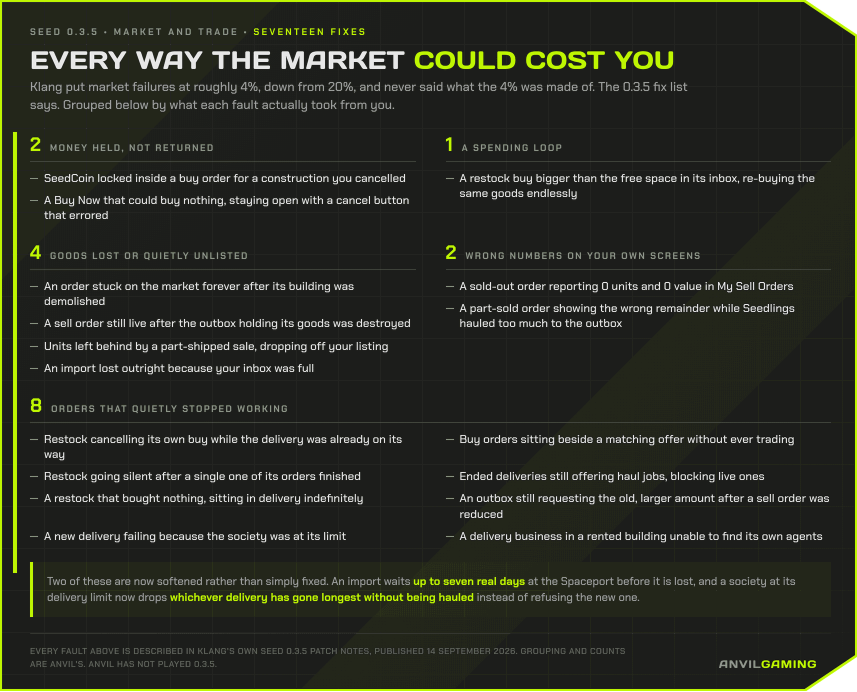

None of that is exotic. It is the ordinary machinery of trade failing in ways that look, from the player's side, like the market simply not working.
Publishing that list is not a comfortable thing for a studio to do. Every line is an admission, written in plain sentences a player can check, rather than buried under "various stability and performance improvements". Klang has been doing this for four patches now, and the habit is worth more to anyone building a business on Avesta than any single fix on the list.
When Klang published its reliability figures, it singled out Auto-Restock as an example of something that still did not work correctly. Here is what "did not work correctly" meant:
Read together, that is a system that could cancel its own work, retire after a single success, hang indefinitely on an empty result, and spend SeedCoin on goods it had nowhere to put. Klang could have fixed one of those, shipped it, and called the system repaired. It went and found all four.
If you switched Auto-Restock off months ago and never went back, this is the patch that earns it a second look. Start it on one cheap line first - not because the studio has not earned the benefit of the doubt, but because that is how you would sensibly restart any system that had let you down.
Our 11 of September analysis told buyers two things: keep space free in your inbox, and understand that responsibility for a shipment can change once it reaches the Spaceport. Half of that advice is now considerably softer.
A global market import delivery will wait up to seven real days at the Spaceport if your inbox is full, rather than being lost. Separately, an automatic restock buy is now capped at the free space in the destination inbox, so the full-inbox failure has been blocked at both ends - once by refusing to over-order, once by holding the goods instead of deleting them.
Seven real days is a generous grace period, and fixing the same failure from two directions in one patch is the sort of thing that suggests somebody actually sat down and mapped the problem. Klang's own line in the notes is "Please make room in your inboxes!", which is fair enough. The studio has come most of the way. The last stretch is still yours.
One more for anyone running a busy society: when a society's deliveries hit their limit, a valid new delivery now replaces the one that has gone longest without being hauled, instead of the new delivery failing outright. Large settlements were losing live trade to stale queued deliveries nobody was ever going to collect, and that is exactly the kind of small, invisible fix that makes a big society feel less like it is fighting itself.
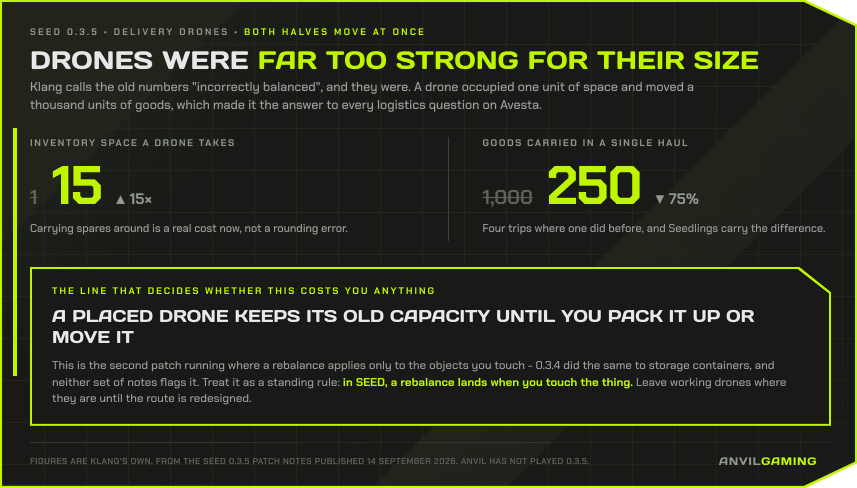
Klang says delivery drones were "incorrectly balanced" - too little volume for too much capacity. The correction is severe. A drone now takes 15 inventory volume instead of 1, and one haul carries up to 250 instead of 1,000.
The studio is right. A drone that occupied one unit of space and moved a thousand units of goods was not a logistics option; it was the answer to every logistics question on Avesta. Tying capacity to the room a thing takes up is the rule most players assumed was in force already, and the game is better for it being true.
Then the line that decides whether this costs you anything: drones already placed keep their old carry capacity until they are packed up or moved.
If that sounds familiar, it should. 0.3.4 rebalanced storage capacity and applied the new numbers only to containers that were new, moved, or unpacked, which turned tidying a settlement into an expensive mistake. Two patches later, the same rule governs drones, and again it arrives as one sentence in a long list. Treat it as a standing rule rather than a coincidence: in SEED, a rebalance applies when you touch the thing.

This is the one place in 0.3.5 where the notes could do more work. Grandfathering is a kindness - it stops a patch from reaching into settlements people spent weeks building - but a kindness nobody is warned about becomes a trap the first time somebody reorganises a warehouse.
Trading contracts now allow just under 30 real minutes to be fulfilled, up from 15. The contract creation and review panels also explain the fulfilment rules more clearly.
Fifteen real minutes only ever worked if you were sitting at the client watching it happen. Thirty survives a distraction, which is the difference between a mechanic you can actually use and one you have to plan your evening around.
0.3.3 capped the votes a single Cultivator could cast at 15%. 0.3.5 moves in the opposite direction and lets Seedlings vote on their own, under four conditions worth reading carefully:
The 50% brake is the important detail and it is a genuinely elegant piece of design. It makes autonomous Seedlings a quorum filler rather than an electorate, which is the difference between unblocking a small society's elections and quietly handing them to whoever has the most absent friends. Getting that distinction right in a system this fiddly is harder than it looks.

Two related changes help small and growing societies the same way. Inactive members who have gone five or more days without placing a tent no longer count against Claimable Plot availability, so a dormant member stops blocking a new joiner. And starting a new society is now blocked on islands that already hold 2,000 or more Seedlings, which pushes new settlements onto quieter ground.
Klang's own wording is that this "should address the majority of market issues". Majority is not all, and the notes publish no revised failure rate - the 20% to 4% figures from 11 September stand unrepeated. That is not a criticism so much as the obvious next question: nobody outside Klang can tell yet what seventeen fixes did to the number, and the number is the thing players will judge it by.

The drone rebalance is also the second time in two patches that a capacity change has depended on whether you happen to move the object, with no line in the notes drawing attention to it either time. One sentence would fix that.
Seventeen fixes is a good patch. A studio that names its own broken system in public, then comes back three days later having fixed it four separate ways, is something better than a good patch - it is the reason SEED is worth the patience it currently asks of people. Just do not move your drones.











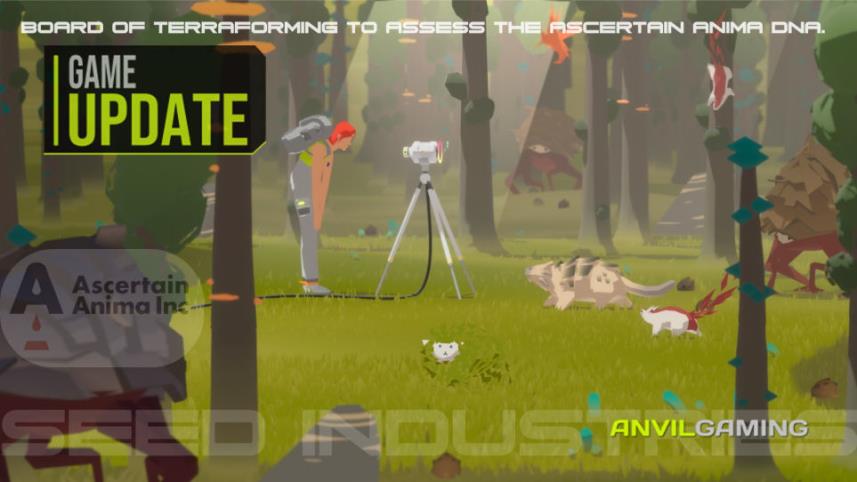
SEED's Dezima Donations event is coming to an end, but the story surrounding it may be far from finished. Spark posts have revealed an Axiom attack, a laboratory breach and DNA reaching Avesta's surface. Now, with a suspicious image showing animals and an unexpected reward teased, we investigate whether Klang has been quietly preparing the planet for new life.
Read More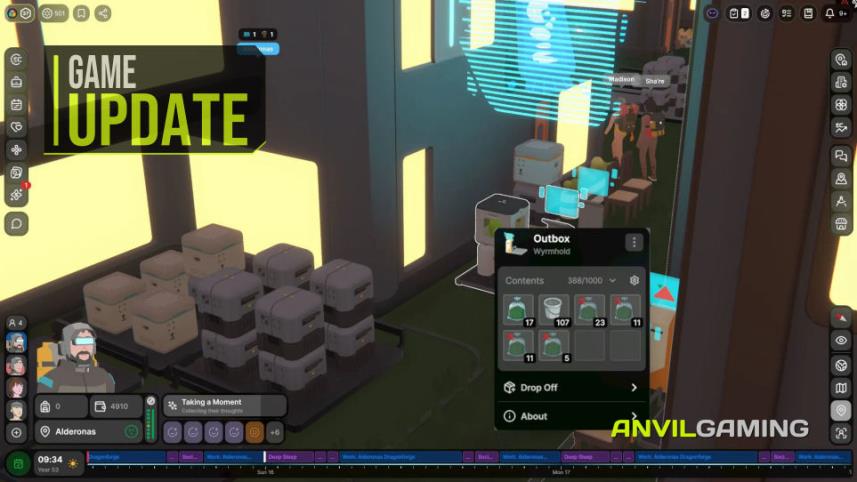
Klang says SEED market failures have fallen from roughly 20% to 4%, but that is not an all-clear. Buyers need free inbox space and scheduled haulers, while responsibility for a lost shipment can change at the Spaceport. Here is who carries the risk now.
Read More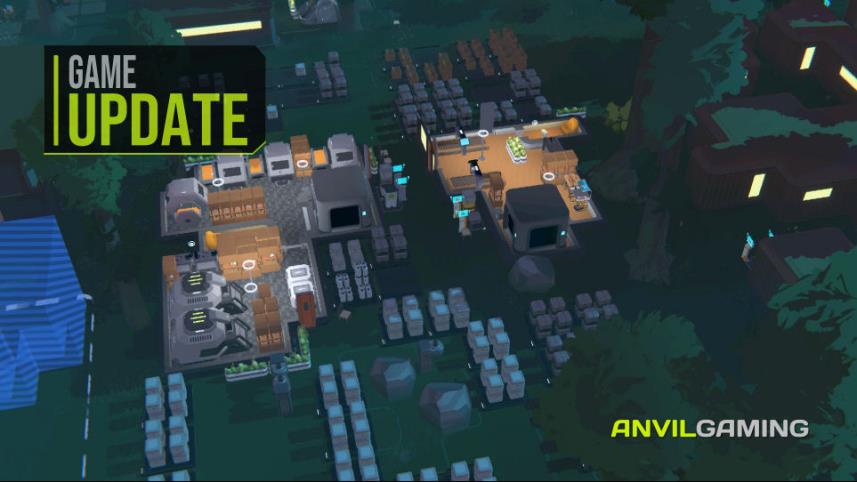
SEED 0.3.4 takes rare ore out of repairs, teaches schedules to explain their failures and stops trees growing back. It also rebalances storage - and because the new capacities only apply to containers you move, tidying up is now the most expensive thing you can do.
Read More
Mundi hosted the Covital Show on SEED's official channel and put the roadmap on screen. 0.4 is City Life - law and order, electricity, organisations, building subdivision, bars. And the board says we are nowhere near the end of it.
Read More
SEED 0.3.3 caps a single Cultivator's votes at 15% of the society population, puts a price on firing a Seedling, and spends the rest of a very long changelog teaching the game to explain its own failures.
Read More
SEED 0.3.2 wraps a summer event around depleting ore, a single-item hierarchy, stronger governance, and a safer market. Our analysis of Klang's official notes and what each change will cost your society.
Read More
Your Seedling isn't lazy - it's following orders. Every event in SEED's Scheduler has its own priority list, and anything past the top few is wallpaper. How events work, why needs deserve their own hour, when a direct order beats the schedule, and a week you can copy.
Read More
A SEED hospital can have a skilled doctor, medicine on hand, and opening hours, yet still collect one-star 'wasted visit' reviews. This guide turns seven weeks of community troubleshooting into one current setup for services, staffing, stock access, and patient schedules.
Read More
Every crafting task in SEED shows three times, and most players read the wrong one. Total Time only says when the output appears - Work Time is what the job actually costs your settlement. Read them that way and the obvious recipe is often the expensive one.
Read More
Health in SEED is not a bar you refill. It is a system of specific conditions, severity tiers and sixteen medical specialisms — and the serious end of it depends on other people.
Read More
What a Seedling does while you are away in SEED — what keeps running, what it decides for itself, what degrades and how fast, and how to end a session so you come back to a life rather than a mess.
Read More
SEED puts you in charge of people who make their own decisions, on a planet that keeps running whether or not you are logged in. One real hour is one day on Avesta. Here is what that actually means to play, what Early Access still gets wrong, and who should not buy it.
Read More
Wyrmhold does not run open recruitment. We take people for a need, after a conversation. This is what the Hold expects of a resident, what it provides in return, who it is honestly not for, and where to come and talk to us.
Read More
Wyrmhold is our society on Avesta. Its founding stories are not decoration - each one encodes a SEED system that will decide whether your own society survives. Here are three of them, and what they are really about.
Read More
The first record of what Wyrmhold actually did. One month, almost no visible expansion, and a great deal of infrastructure - the survey, the Kernel, the Dragonforge Ward workshops, the Elderwyrm department, an election, and the Hold's first registered business.
Read More