
GAMING
Loading





Open any crafting task in SEED and the game tells you something most players read straight past. There are three times on the card, not one, and the biggest number is the one that matters least.
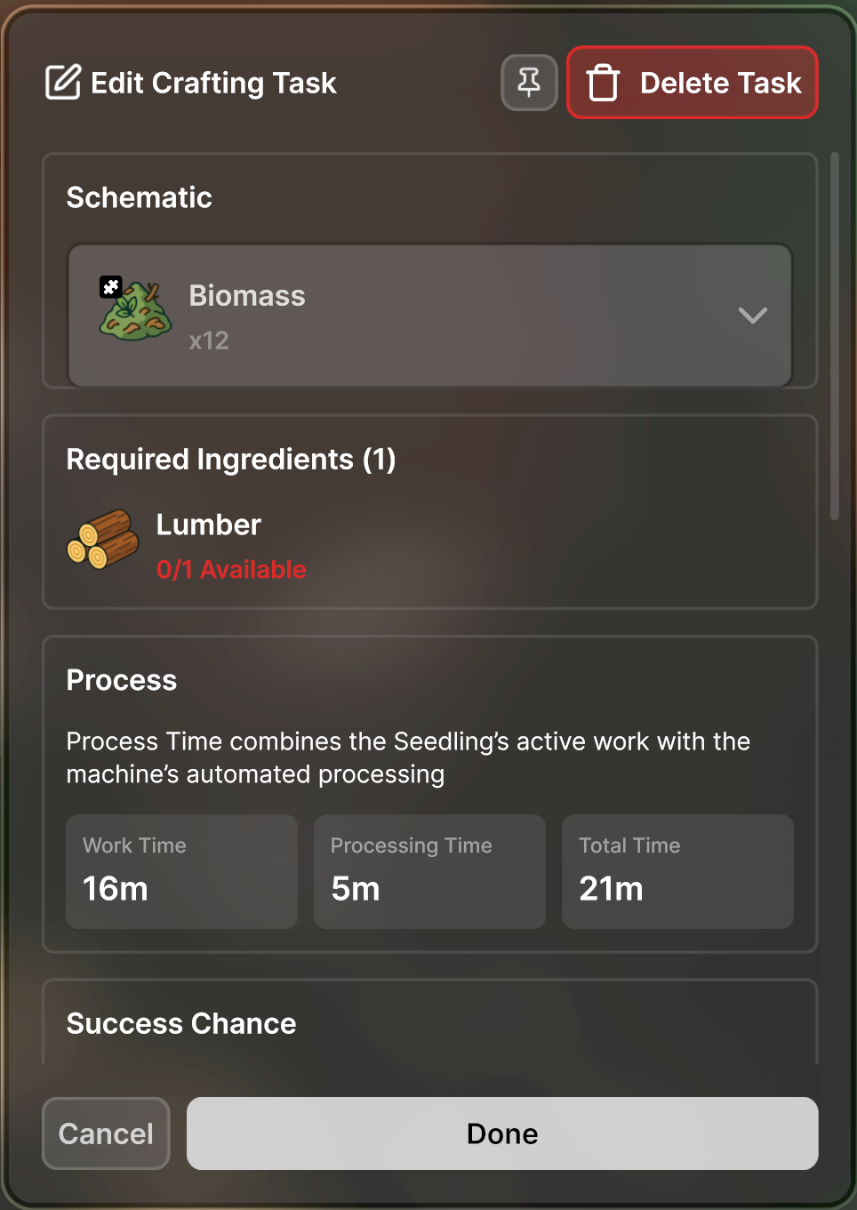
Set up a crafting task and look above the numbers:
Process Time combines the Seedling's active work with the machine's automated processing.
Then three figures. Biomass from a single Lumber at a chemistry station reads Work Time 16m, Processing Time 5m, Total Time 21m.
Those are not alternatives. They are two phases of one job, and they add. Your Seedling works the machine for sixteen minutes, then the machine finishes the last five on its own. After Work Time elapses, your Seedling walks away and starts whatever is next in its queue. The machine keeps going without it.
Which means Total Time is a description of when the output appears. It is not a bill. The bill is Work Time, because that is the only part billed to a Seedling's day - and a Seedling's day is the one genuinely scarce thing in a settlement.
Most recipes have no machine phase at all. Of the 730 recipes in the game's data that carry a time, 634 are pure Work Time - the Seedling does the whole job start to finish, and Total Time and Work Time are the same number.
The other 96 split into two phases, and across those the Seedling's share is a median of 21%. Four fifths of the clock, on average, is the machine working alone.
At the far end sit the extractors, where a Seedling's involvement is around one percent: eighteen minutes to set an extraction going, then two to three days of machine time nobody attends. That is not a slow recipe. It is a cheap one, wearing a big number.
Here is where reading the wrong number costs you properly, and it happens on an item every settlement needs.
SEED has two ways to make bandages, and in the item list they carry the same name.
Identical Work Time. Four times the output. Every instinct says take the first one.
Now price the Fabric, because Fabric is not something you pick up. Work back up the textile chain, all of it at Tailoring level zero:
One Fabric costs roughly 119 minutes of a Seedling standing at a loom. Two of them, plus the eight-minute bandage step, is about 246 minutes for 24 bandages. That is a little over ten minutes of Seedling time per bandage.
The raw-Flaxa recipe is eight minutes for six. One minute twenty per bandage.
The advanced-looking route costs nearly eight times more of the only resource you cannot make more of. Both cards show 8m. Nothing on either screen tells you this.
And there is a second reason to take the raw-Flaxa recipe early: retting and weaving both happen at a weaving loom, which is Engineering Lv 10. Until you have one you cannot make Fabric at all, so the expensive bandage is not merely worse - it is not available. When it does become available, it is still worse.
Everything above assumes you can choose. Often you cannot, and that is the part a recipe comparison hides.
Machines sit on an Engineering ladder, and the good recipe is frequently on a rung you will not reach for weeks. Three tiers, roughly:

So read the sections below as two different things: what to do with the machines you have, and what the ladder is actually worth climbing for.
Iron rods, and this is the one to change this evening. Both recipes exist early enough to matter, and the cheap machine wins.
Two minutes quicker on the card. A third of the output, for double the ingots, on a machine that costs an order of magnitude more to build. The metalworking bench is not the beginner's version of the lathe for this job - it is simply better at it, and it stays better.
That is the shape worth looking for: a first-week machine that quietly beats its expensive replacement at one specific recipe.
These two you probably cannot do yet. They are here because they are the reason to push Engineering rather than settle.
Seeds - the payoff applies to every crop in the game. Wheat, corn, tomato, pumpkin, herbs, flaxa, saplings, all on identical numbers.

The separator is what you will have, and for a long time it is the only thing you will have. It is not a mistake - it is the whole seed economy of an early settlement. But the growbox is two and a half times better per Seedling-minute, on every crop, permanently, and that is a real answer to "what is Engineering Lv 30 for".
Wood planks, where the longer number is the better deal.
The table saw's card shows a longer Total Time, and it is twice as good, because those extra sixteen minutes are the machine's, and the machine is not on your payroll. Worth building - but worth knowing you are buying throughput, not speed.
Three questions, in this order.
Processing Time is free. Spend the other one carefully - and spend your Engineering levels on the machines that pay it back.











SEED puts you in charge of people who make their own decisions, on a planet that keeps running whether or not you are logged in. One real hour is one day on Avesta. Here is what that actually means to play, what Early Access still gets wrong, and who should not buy it.
Read More
Your Seedling isn't lazy - it's following orders. Every event in SEED's Scheduler has its own priority list, and anything past the top few is wallpaper. How events work, why needs deserve their own hour, when a direct order beats the schedule, and a week you can copy.
Read More
An onboarding guide to a new player's first hours in SEED on Avesta: what a Seedling actually is, the survival mistakes that cost a day, why the Scheduler matters more than anything you build, and what to ignore until later.
Read More
A SEED hospital can have a skilled doctor, medicine on hand, and opening hours, yet still collect one-star 'wasted visit' reviews. This guide turns seven weeks of community troubleshooting into one current setup for services, staffing, stock access, and patient schedules.
Read More
Health in SEED is not a bar you refill. It is a system of specific conditions, severity tiers and sixteen medical specialisms — and the serious end of it depends on other people.
Read More
What a Seedling does while you are away in SEED — what keeps running, what it decides for itself, what degrades and how fast, and how to end a session so you come back to a life rather than a mess.
Read More
SEED's Dezima Donations event is coming to an end, but the story surrounding it may be far from finished. Spark posts have revealed an Axiom attack, a laboratory breach and DNA reaching Avesta's surface. Now, with a suspicious image showing animals and an unexpected reward teased, we investigate whether Klang has been quietly preparing the planet for new life.
Read More
Klang named its own broken system in public and came back three days later having fixed it four separate ways. The fix list is long enough to finally itemise what trade was costing people. The drone rebalance is the bill, and it charges only those who tidy up.
Read More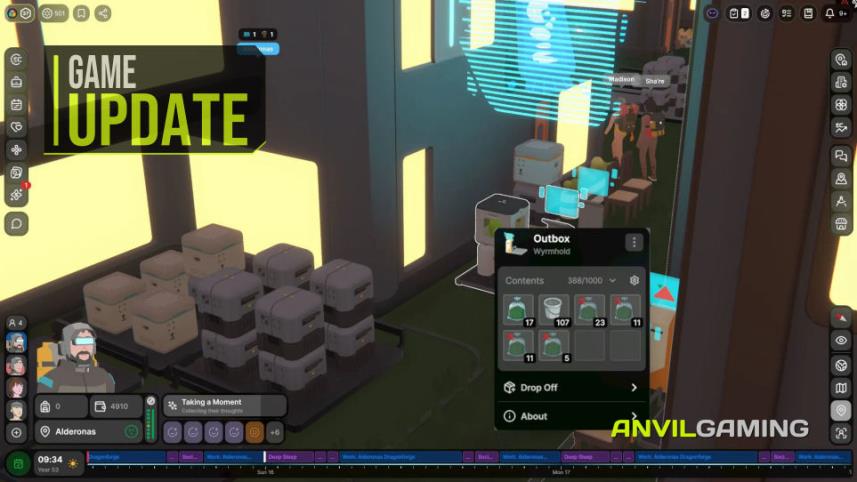
Klang says SEED market failures have fallen from roughly 20% to 4%, but that is not an all-clear. Buyers need free inbox space and scheduled haulers, while responsibility for a lost shipment can change at the Spaceport. Here is who carries the risk now.
Read More
SEED 0.3.4 takes rare ore out of repairs, teaches schedules to explain their failures and stops trees growing back. It also rebalances storage - and because the new capacities only apply to containers you move, tidying up is now the most expensive thing you can do.
Read More
Mundi hosted the Covital Show on SEED's official channel and put the roadmap on screen. 0.4 is City Life - law and order, electricity, organisations, building subdivision, bars. And the board says we are nowhere near the end of it.
Read More
SEED 0.3.3 caps a single Cultivator's votes at 15% of the society population, puts a price on firing a Seedling, and spends the rest of a very long changelog teaching the game to explain its own failures.
Read More
Wyrmhold does not run open recruitment. We take people for a need, after a conversation. This is what the Hold expects of a resident, what it provides in return, who it is honestly not for, and where to come and talk to us.
Read More
Wyrmhold is our society on Avesta. Its founding stories are not decoration - each one encodes a SEED system that will decide whether your own society survives. Here are three of them, and what they are really about.
Read More
The first record of what Wyrmhold actually did. One month, almost no visible expansion, and a great deal of infrastructure - the survey, the Kernel, the Dragonforge Ward workshops, the Elderwyrm department, an election, and the Hold's first registered business.
Read More