GAMING
Loading





Friday's Covital Show was a party, and the most useful part was hiding between the dance numbers.
Among four island dance crews, a live poll and a cameo from PAM, Marijn Zwemmer, a senior game engineer at Klang, explained the machine to host John Holten. How Seedlings and delivery drones choose a path. Why one plot with 520 shelves can drag an island down. And how close the Mobile Transport Unit is. It's been ready for a while, apparently. It could be a week or so away, with no promise attached.
The rest, quickly. Automated repeat deliveries are being built, and conveyor belts are on the "at some point" list. A new sign system built on icons is in the works. Klang is teaching Seedlings to actually talk to each other at gatherings, instead of sprinting in and standing about. And the great island dance-off went to Bong, on the chat's vote, with a Celtic number. That's not a sentence I expected to write about a society simulator.
This write-up is based on the Covital Show broadcast of Friday 2 October 2026 on SEED's official Twitch channel - the full show is still up there, and it's worth a watch - checked against our coverage of the 0.4 reveal and The Notice Board, Klang's lore blog, and SEED's game data. Klang's plans and timings are reported as Klang gave them. The readings, the figures and the opinions are ours. Nothing here is a hands-on test.
The best ten minutes of the night started with corn.
One of the community clips showed a corn maze, and the obvious question followed: can Seedlings get lost in it? Not really. As Marijn understands it, corn doesn't block navigation, so your Seedlings will stroll straight through the middle of your maze as if it isn't there. Somebody suggested making them avoid corn, at which point they really could get stuck in one. That'd be funny. It'd also be a proper maze.
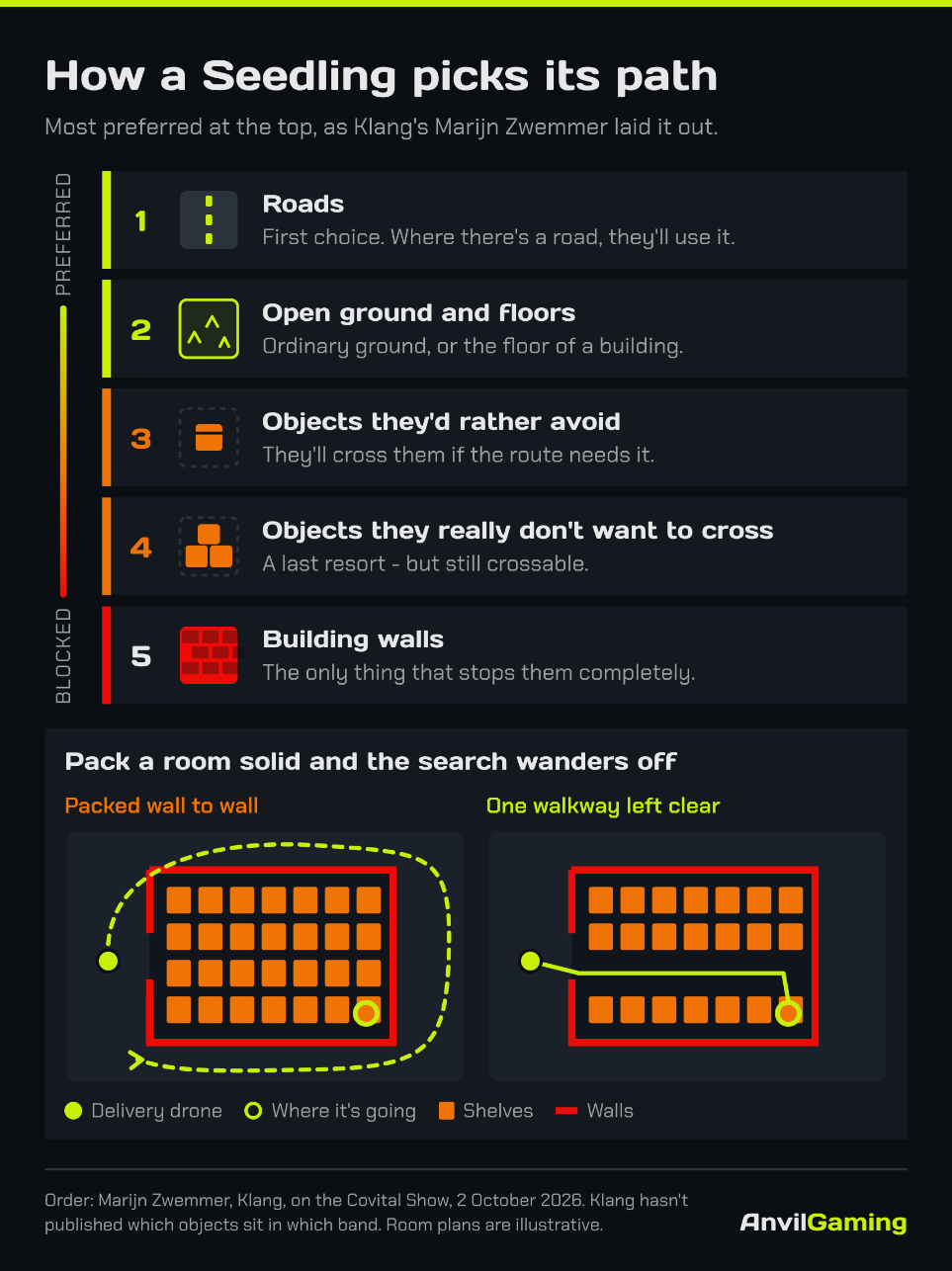
Then came the useful part, prompted by a question from Discord. When a Seedling picks a route, this is the order it thinks in:
So it's very hard to trap a Seedling. Fence something in with furniture and, sooner or later, they'll wade through the furniture. If you've ever watched one take the scenic route through your nicely arranged room, that's why.
The exception is a room with nowhere left to stand. Last week a Duck Delivery Drone got stuck because somebody had packed a building full of objects - shelves, he thought. The drone had to get through a run of them to reach its spot, and lost the thread somewhere along the way. It started hunting for a route from the other side of the city to a corner tucked behind the shelving. He couldn't remember whose building it was, which is probably kindest all round.
Klang wants to stop that happening in general. Until it does, my advice is simple. Put roads where you want traffic, and leave a walkway through any room you're filling with storage. Seedlings and drones will push through clutter when they have to, but a room packed wall to wall can send the search off across the whole city. A corridor costs you a row of shelves. A lost duck costs you the delivery.

Marijn's other story was about density. As an engineer, he said, you mostly look at a city because something's wrong in it. Right now one city has a plot carrying about 520 shelves, all in one building. Klang's AI doesn't like it. Every time a Seedling working there asks itself what to do next, it checks every single shelf. They try to be a little bit smart about it. It's still 520 shelves.
That's the clearest answer we've had to the question SEED players ask most: why does one island lag more than another? Usually, Klang said, it's because some places on an island are extremely heavy. Klang allocates a certain amount of objects to each server, and a 500-shelf plot can leave that allocation a bit off. So the studio has to watch what players actually build, and adjust slowly. Two more exhibits from the week: a building with 1,500 doors, which was a bug and did break things, and somebody keeping around 150 ducks in a single room. At 500 ducks, the panel reckoned, it would start to get really weird.
Then came the dare. Someone on the panel challenged the world to build a territory-sized maze. By the time it had grown into "a territory-sized maze of ducks", someone else was asking, quite sincerely, for nobody to actually do it, because it'd be a problem. After the last paragraph, I believe them.
On my reading, that makes lag partly a neighbourhood problem. Your island's performance depends on what everyone on it builds, not just on what you build. That's no reason to stop building big. It's a reason to report lag properly - the island, the time, and what froze - exactly as The Notice Board keeps asking, because that's how Klang finds the 520-shelf plot.
Help is on its way. Marijn expects larger server changes in a couple of weeks, and said they should make quite a big difference. Reconnection problems are being fixed as they turn up, and they keep turning out to be different cases. Klang reads the surveys, the bug reports, and Discord, so keep reporting.
One more thing on shelves. Wednesday's Notice Board previewed the new vertical shelf, and the panel pointed back to it. With no limit on how many you can place, Marijn expects people to keep building huge plots. When the new shelf lands, celebrate with a dozen. Not 520.
Four weeks ago, the Mobile Transport Unit was the item from September's roadmap reveal we were most looking forward to and most suspicious of. On Friday, Marijn said it's actually been ready for a while and is coming soon. The guess was one to one-and-a-half weeks, followed straight away by a request not to hold anyone to a date. Klang wants to release it alongside a couple of other things. It has sound now. It has lights.
That claim checks out. The MTU has been sitting in SEED's game data since the 0.3.5 release in mid-September. The file calls it "a large, slow walker built by Frontiers Engineering to haul cargo across the frontier", and it comes with a docking station because it "needs to recharge sometimes". And 0.3.7 made it slower, not faster: its walking-speed value dropped from 0.85 to 0.765, which is under a sixth of a Duck Delivery Drone's. Its collision radius is three times a drone's, and it has room for 4,510 against a drone's 250 per haul. It's also flagged as needing a clear path, which the drone isn't.
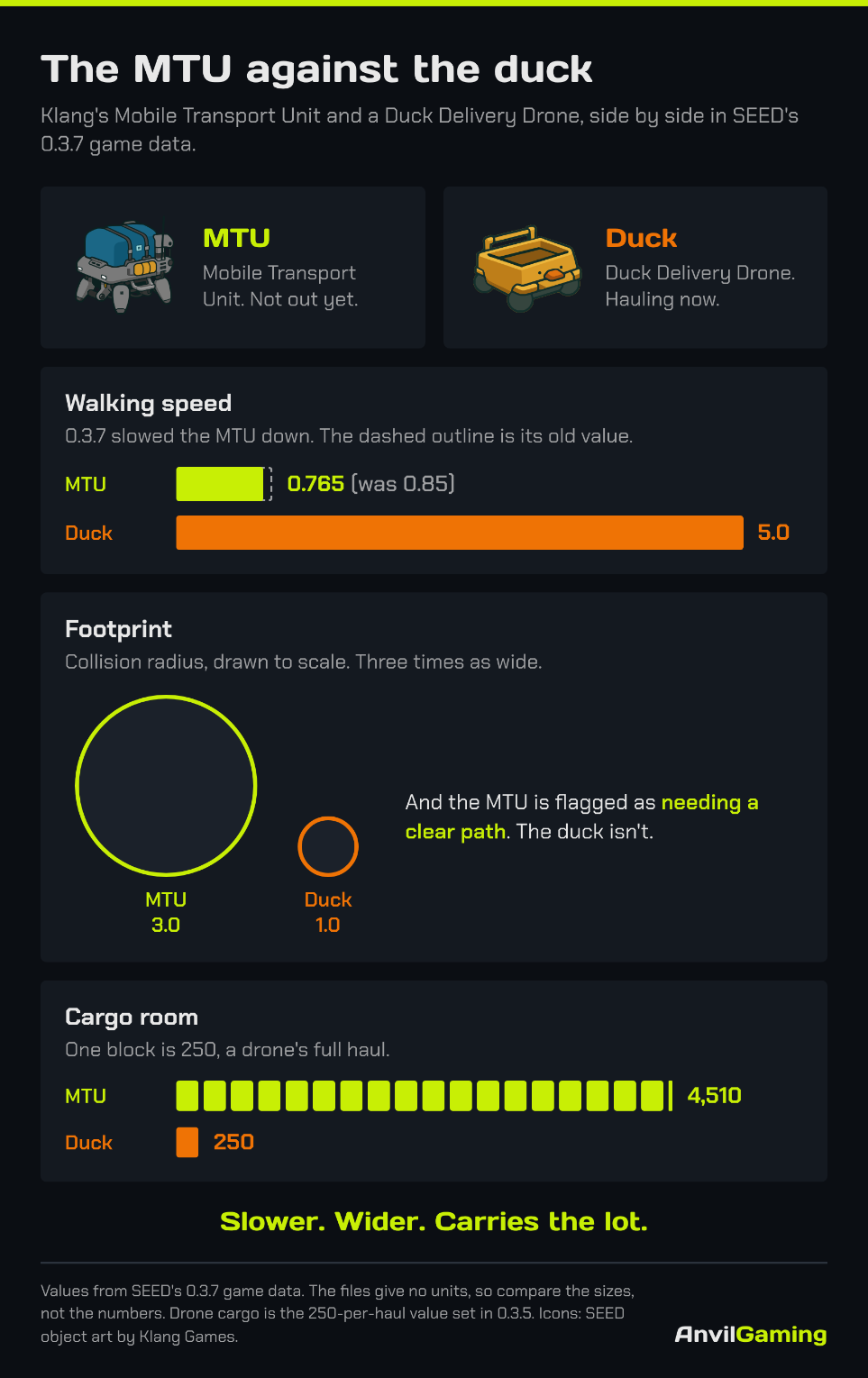
Put that next to the navigation lesson above. Seedlings and drones will wade through clutter when they must. A big, slow walker that needs path clearance probably won't. That's our reading of the data, not something Klang has said. But if you're planning where an MTU will come and go, I'd give it a road.
When September's show called it expensive, it wasn't joking. The 0.3.7 data has the recipe: an Electronics Workbench, Engineering 30, and a shopping list led by 915 Passivated Steel Sheets - a new part, each one a Steel Sheet treated with five Nitric Acid at a Basic Anvil. Then 90 Titanium Plates, 60 Steel Beams, 18 Composite Panels, 18 Pistons, 12 Motor Housings, four Electric Motors, and two Computer Modules. Both recipes are tied to a feature switch, and the files don't say whether it's on, so don't start stockpiling sheets until Klang says you can build one.
Klang wants it to change how far people travel, too. Societies are still sticking close to their own territory, Marijn said, and the studio hopes people start going further out. It's nudging that along slowly. A slow walker seems like the right tool for a slow nudge.
Marijn couldn't resist one spoiler: automated deliveries. You'll be able to set up repeated deliveries between different locations. At the moment you can sort of do it with contracts, which are limited, or with one-time deliveries, which you have to keep setting up by hand. He's seen the screenshots of the delivery setups people run manually, and called them completely insane. Understandable, given every one of them is done by hand. Automation still has to be built, so there's no date.
That lines up with Wednesday, when Klang said single-item hauling is getting a lot of attention. Two shows, one direction: fewer clicks for the same goods.
A viewer then asked for conveyor belts. At some point, probably, came the answer, followed by the most interesting design statement of the night. Delivery drones are expensive on purpose, because they take work away from Seedlings. Right now drones need no maintenance at all, and Klang will see whether it stays that way. Anything you can automate completely is, in the panel's view, finished - and then what's the game? Factorio and Satisfactory players might be fine with that. SEED, the show reminded everyone, is "a dance with entropy". Things wear out. And Klang wants Seedlings to keep their jobs.
I like this a lot. It's a studio saying out loud what its game is for, and it explains prices that otherwise look like a tax on convenience. It's also a warning worth hearing. If your business plan assumes drones stay maintenance-free forever, Klang has just told you they might not. Someone on the panel called Seedling employment a real-world issue. Fair.

One of the clips in the "SEED is..." montage showed a society holding a gathering, everyone converging on one spot. Events aren't a feature yet, but players are making them happen anyway. Marijn's eye went straight to what isn't working: Seedlings running in too fast, and not casually chatting once they've arrived. Klang is actively working on that, so a gathering turns into Seedlings doing something together. Sitting down. Having a conversation. An actual party.
Gatherings were a tile on the 0.4 board in September, set to run through Spark and the Scheduler. This is the first we've heard of the unglamorous half: making the guests behave like guests. The panel made the bigger point, too. People doing things together, over and over, is how a place grows an identity. A party that works is how SEED gets a culture.
Klang's team has spent the past week on a new building sign system: modular, built around icons, and in the panel's view a big change for cities and street life. It isn't the first go at this. Klang prototyped advertising billboards about two years ago - your own image, for a political campaign or a product - and never shipped them. There's also a small prototype of a signpost for elections, to help a society manage its messaging and mark what an area is for.
On Wednesday, custom-text billboards came up as a suggestion, and we said a public billboard is a feature for about four minutes and then a moderation queue. Icons are a neat way round that. Whether Klang chose icons for that reason, nobody said. But a sign that can point to the farm and the polling station without letting anyone type a word is the version I'd ship first.
Cities are already decorating more, with roof pieces and images on the sides of buildings - the attachments 0.3.6 made buildable. Marijn said spotting a crazy setup is the fun part of checking cities for bugs.
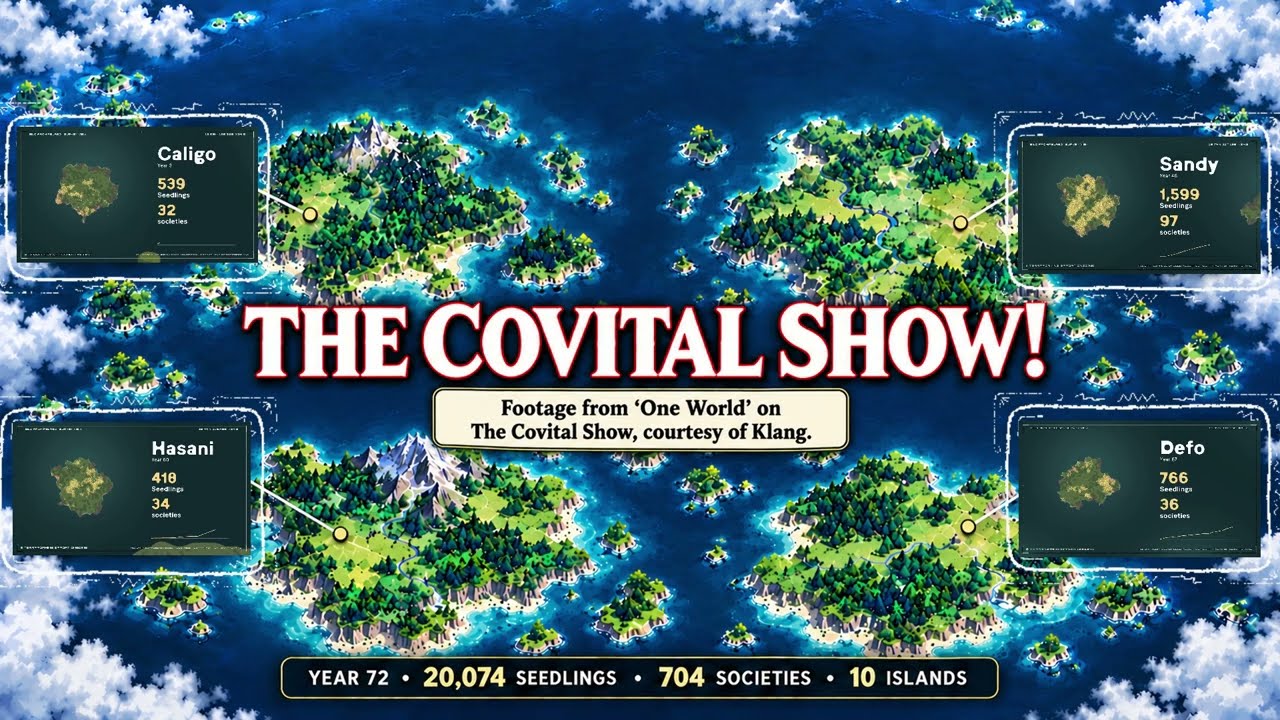
Then the party itself. "Avesta: One World" was billed as a celebration of everyone sharing one planet, and its second half was, by John's own description, a Eurovision version of the Covital Show. Four island crews danced on purpose-built sets for a chat poll. Clinamen, Monada and Bong are all islands of the Eilo Archipelago, which Klang's lore calls the oldest inhabited ground on Avesta.
All of it is built from years of the animation team's work, with costumes and sets from the art team. Most of what you saw is in the game already, the panel said, though not all of it, and things do get removed over time. If you spotted something you want back, screenshot it from the stream and post it on Discord.
For the record, SEED's game data already holds a test item called Dance Floor, described as "A place to let go and just dance." A test item isn't a promise. It's a very good description, though.

Klang's numbers, as the clip gives them:
Klang now runs two shows, and they do different jobs. The Notice Board answers the community's list. The Covital Show explains the machine. Put this week's two next to September's 0.4 reveal, and you can watch several threads move at once:
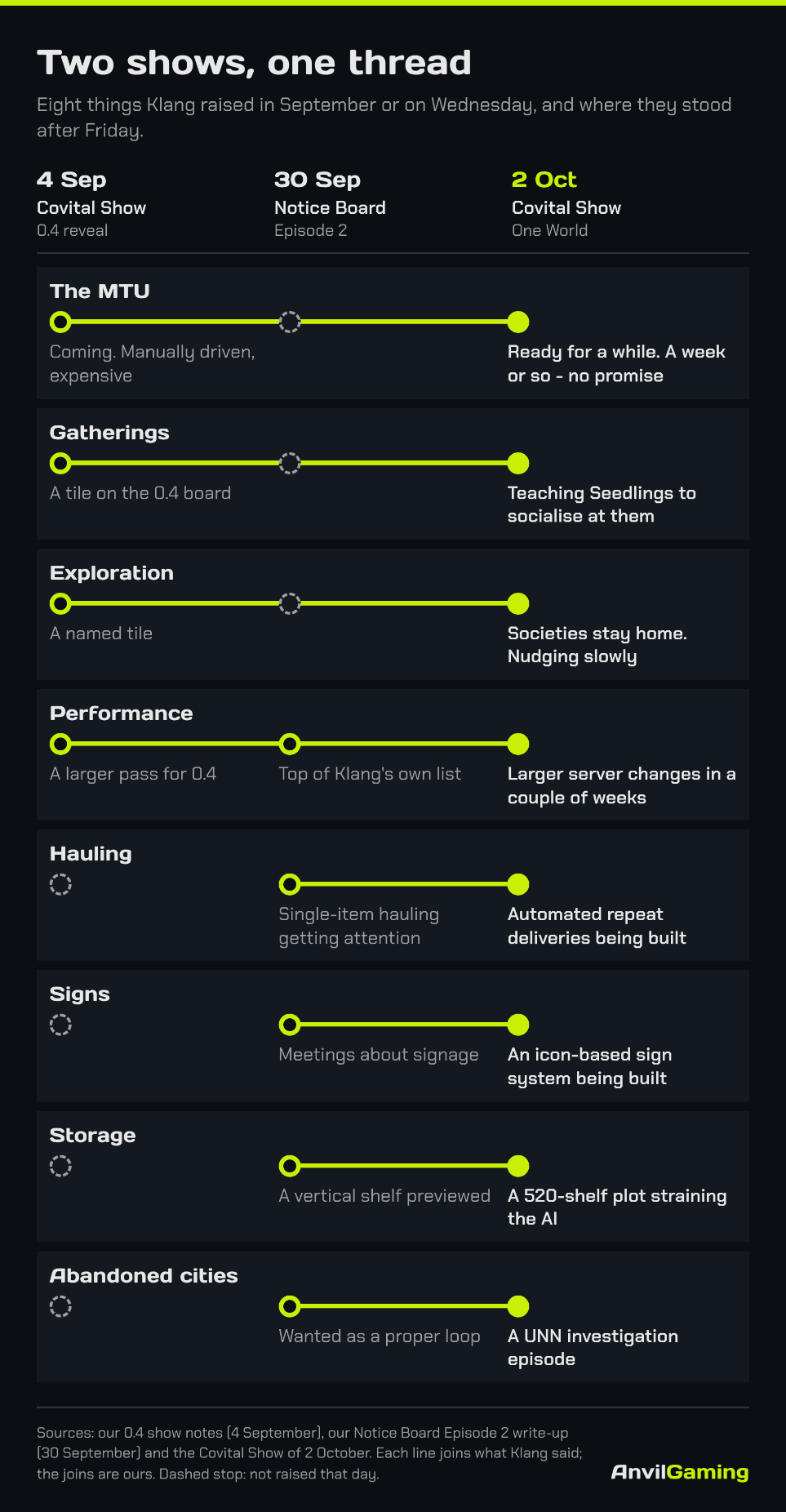
This was the Covital Show at its best, and not because of the dancing - though the chat would argue with me there. It's because Klang let one of its engineers explain how the game works, in plain words, with examples from real cities. That's the Covital Show I want: the reason behind the thing you saw happen on your screen.
Not everything was firm. The MTU date is a guess with a disclaimer stapled to it, and the server changes are a couple of weeks off. But I came away knowing how to lay out a storage room, why an island lags, and what Klang thinks automation is for. That's a good Friday.















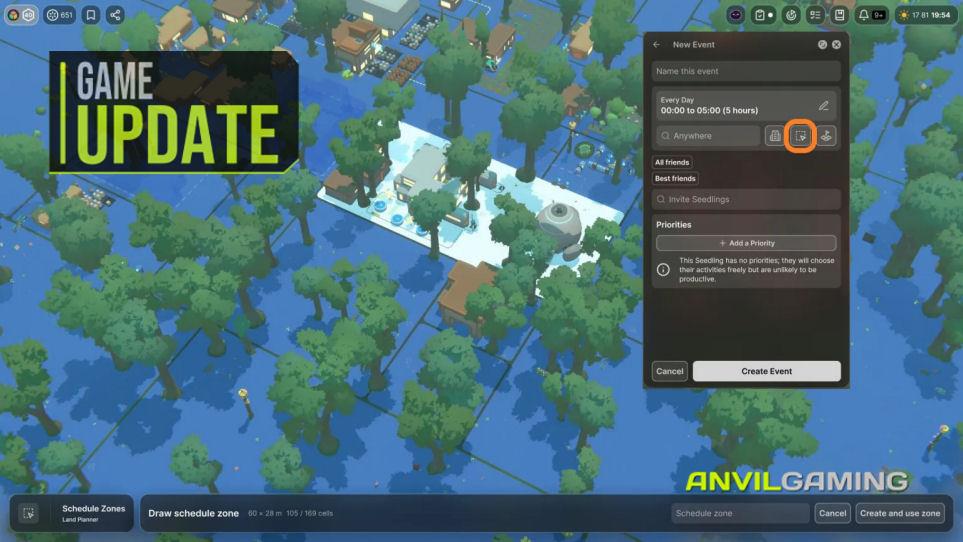
SEED 0.3.8 lets you draw a zone and send a Seedling to clear it, ends the storage grace period without losing anyone's goods, and lets you choose who inherits when a Seedling dies. We checked it against Klang's own top five problems. Four got real work. The fifth got Monkey Bars.
Read More
Last week storage topped SEED's wish list. This week Klang put a shelf on screen, art done and code under way, expected within a fortnight. Our one-week scorecard: the refunds landed, the bug list didn't come back, and the griefing response is still owed. Plus the herds and 0.4.
Read More
SEED 0.3.7 puts wild Anima Herds on Avesta, and Klang's own lore traces them to the Dezima breach the donation event was built around. Returning players also get two real hours to answer a Seedling instead of ten minutes, and big trees can finally leave big seeds.
Read More
Klang's new Wednesday show opened with SEED's 25 worst bugs, ranked and explained how the ranking is made. By our count, market faults carry two-fifths of the pain, while storage dominates what players ask for. What was promised, what was not, and how to push a bug up.
Read More
Forty building attachments existed in SEED with no recipe to make them, and twenty-three more required rare ore. One patch fixes both. Underground water refills itself now, unless you stack pumps on it. The cheapest thing in this update is caring how your settlement looks.
Read More
SEED's Dezima Donations event is coming to an end, but the story surrounding it may be far from finished. Spark posts have revealed an Axiom attack, a laboratory breach and DNA reaching Avesta's surface. Now, with a suspicious image showing animals and an unexpected reward teased, we investigate whether Klang has been quietly preparing the planet for new life.
Read More
Your Seedling isn't lazy - it's following orders. Every event in SEED's Scheduler has its own priority list, and anything past the top few is wallpaper. How events work, why needs deserve their own hour, when a direct order beats the schedule, and a week you can copy.
Read More
A SEED hospital can have a skilled doctor, medicine on hand, and opening hours, yet still collect one-star 'wasted visit' reviews. This guide turns seven weeks of community troubleshooting into one current setup for services, staffing, stock access, and patient schedules.
Read More
Every crafting task in SEED shows three times, and most players read the wrong one. Total Time only says when the output appears - Work Time is what the job actually costs your settlement. Read them that way and the obvious recipe is often the expensive one.
Read More
Health in SEED is not a bar you refill. It is a system of specific conditions, severity tiers and sixteen medical specialisms — and the serious end of it depends on other people.
Read More
What a Seedling does while you are away in SEED — what keeps running, what it decides for itself, what degrades and how fast, and how to end a session so you come back to a life rather than a mess.
Read More
SEED puts you in charge of people who make their own decisions, on a planet that keeps running whether or not you are logged in. One real hour is one day on Avesta. Here is what that actually means to play, what Early Access still gets wrong, and who should not buy it.
Read More
Wyrmhold does not run open recruitment. We take people for a need, after a conversation. This is what the Hold expects of a resident, what it provides in return, who it is honestly not for, and where to come and talk to us.
Read More
Wyrmhold is our society on Avesta. Its founding stories are not decoration - each one encodes a SEED system that will decide whether your own society survives. Here are three of them, and what they are really about.
Read More
The first record of what Wyrmhold actually did. One month, almost no visible expansion, and a great deal of infrastructure - the survey, the Kernel, the Dragonforge Ward workshops, the Elderwyrm department, an election, and the Hold's first registered business.
Read More