
GAMING
Loading





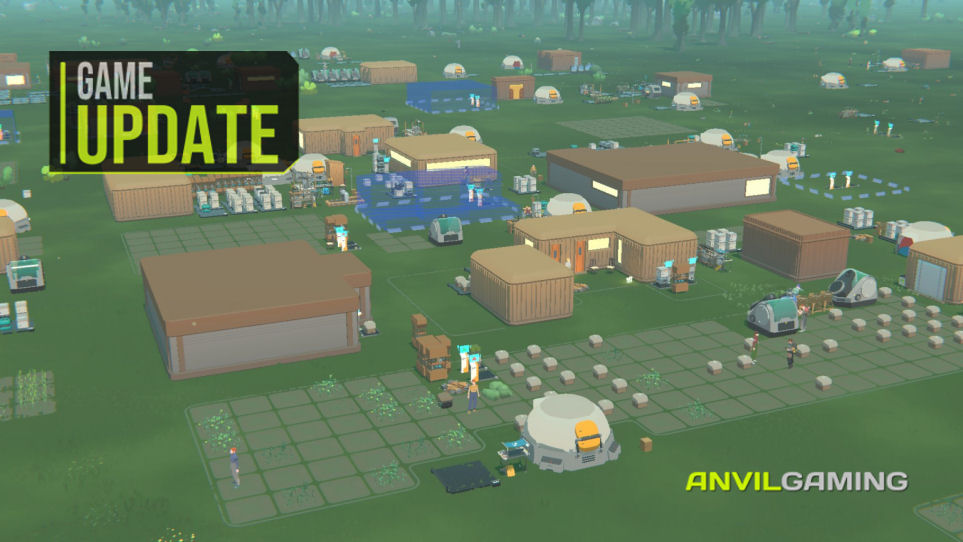
The bare roof was never your fault.
If you have looked at a finished workshop in SEED and thought it still resembled a shed with ambitions, 0.3.6 has an answer, and it is not that you needed more Engineering. Forty building attachments existed in the game with no way for anyone to obtain them. Roof tanks. Ventilation units. Generators. Antennas. Billboards. Lightboxes. Roof and wall lights. Planters. Wall art. They sat in the game as things buildings could have, and there was no recipe to make a single one.
There is now, for all forty. And twenty-three attachment recipes that did already exist have had their rare-ore parts swapped for plain materials, which Klang describes as cutting their rare-ore cost sharply.
Klang has headed the notes for this one building attachments and time tools, and both halves are real. The building half is the one that changes what your settlement can look like by the weekend.
We have not played 0.3.6 yet. Everything below is read from Klang's published notes, with the recipe figures taken from SEED's own data as it stood before this patch.
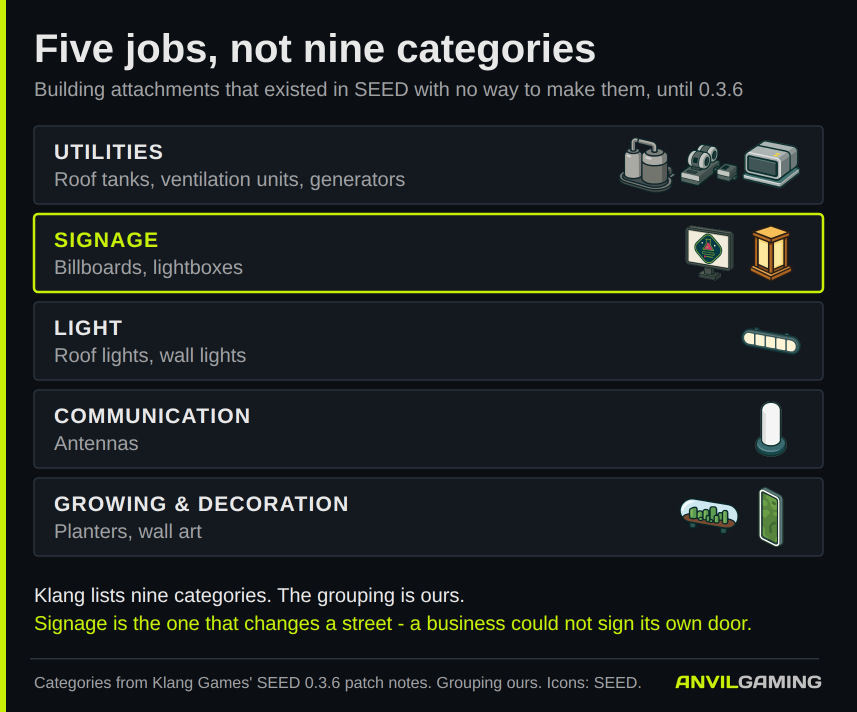
Klang lists the new recipes as nine categories, which is a slightly deflating way to describe the most useful thing in the patch. Grouped by what they actually let you finish, they look considerably better:
The signage entry is the one worth stopping on. SEED has had player-run service locations, entry fees, review scores and staff rotas for months, and until this patch a business could not put a sign on its own frontage. Every venue on Avesta was a shop with an unmarked door. Forty recipes is a pleasant number; the sign is the one that changes how a street reads.
None of this is new content, and that is the point. Klang has gone back through its own game looking for places where a player wanted to do something and found nothing there. That is unglamorous work, it does not make a trailer, and it is the single most reliable signal that a studio is reading what players actually do.
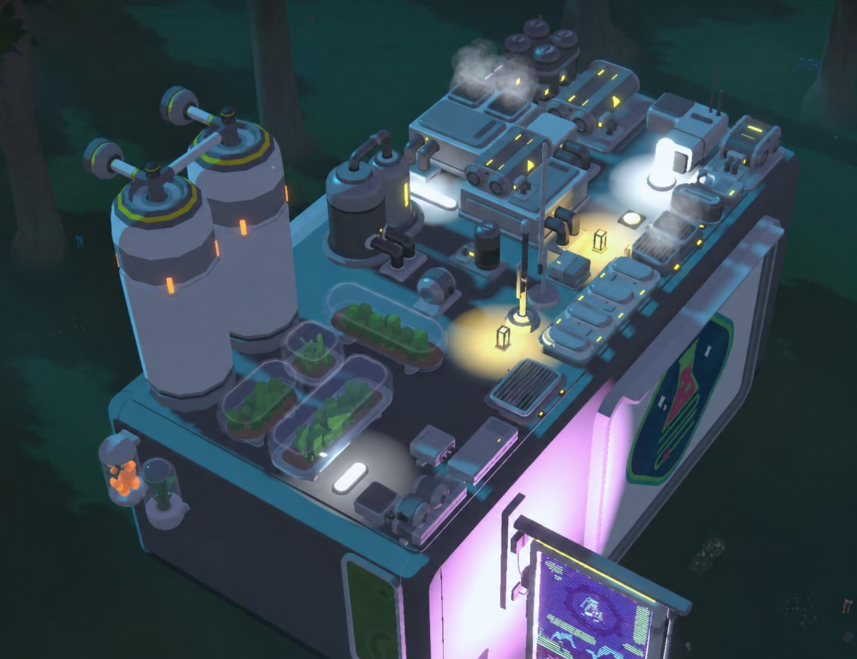
There is one more thing in this section, and it is not in the writing. The illustration Klang runs alongside it shows a rooftop loaded with the new parts - tanks, vents, a generator, planters, lights, the lot - and sitting in the middle of the picture is the game's own refusal, in a little grey box: Too many attachments.
So there is a limit. The notes never mention one, never say what it counts, and never say whether it is per building, per roof or per surface. Klang has illustrated its own cap by accident, which is a very funny way to find out about it, and you will want to know the number before you plan a frontage around six lightboxes.
Twenty-three existing attachment recipes now use plain materials where they previously wanted rare-ore parts. Two building palettes move the same way: the High Tech palette drops the Composite Panel for a new Insulation Panel, crafted from Synthetic Fabric and a new Insulation Foam, and the Plaxin Building Palette now asks for Concrete and Treated Wood instead of a Steel Beam and an Aluminum Frame.
Read those three lines together, and they are one decision, not three.
In 0.3.2 Klang made underground deposits finite, and we wrote at the time that a rich find had become an opportunity with an expiry date. That change did something else as well, quietly. It made every unit of Aurite, Argentite, Bauxite and Rutile a thing you weighed before you spent, which meant nobody sensible spent one on a wall light. Decoration you cannot afford is not decoration. It is a tax on caring what your settlement looks like, and a finite deposit made that tax compound.
0.3.6 removes it from twenty-three recipes and two palettes at once. Klang does not say the two patches are connected, and it does not have to; the effect on your stockpile is the same either way. The four ores go back to being what they should be, which is the price of the things that genuinely need them.

Here is the part the notes do not explain, and it is the reason most players never realised they were paying this.
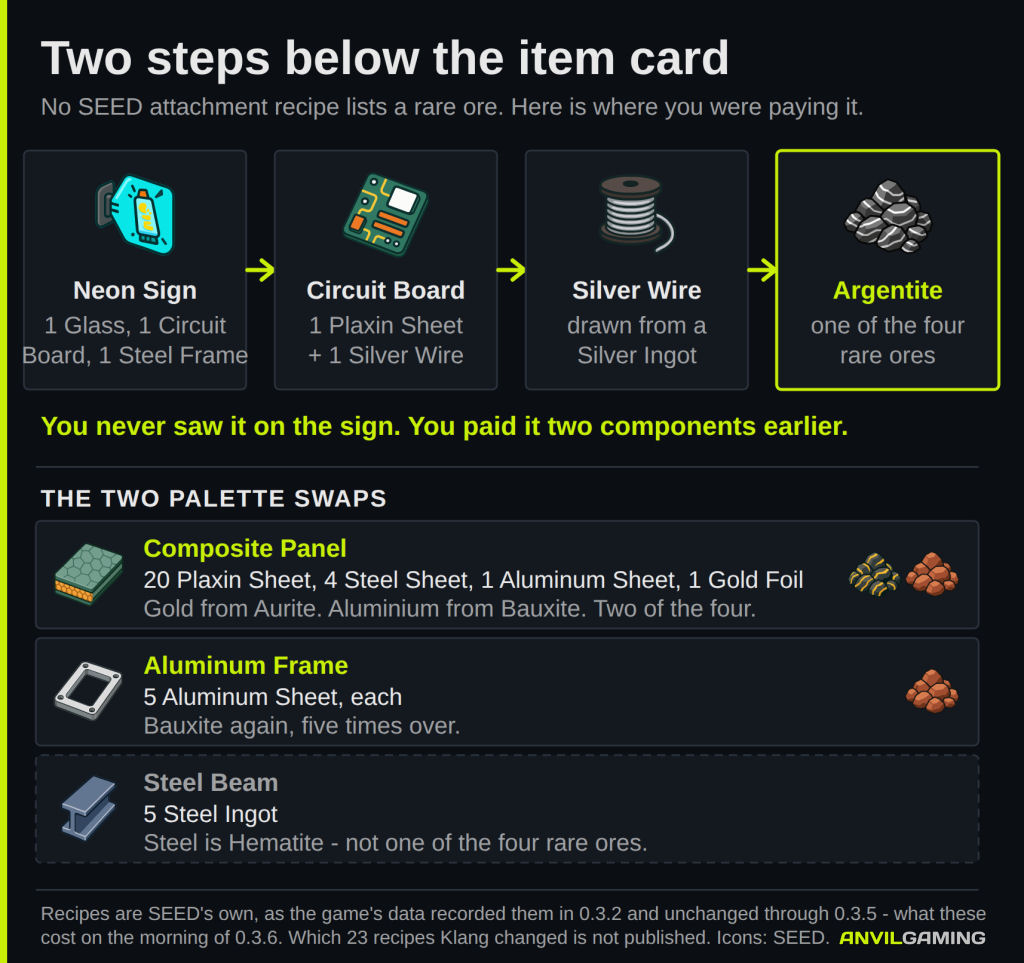
Go through SEED's own recipe data for building attachments as it stood before this patch and you will find something odd: not one attachment recipe lists a rare ore. Not a gram of Aurite, Argentite, Bauxite or Rutile anywhere in the list. So where is the rare-ore cost Klang says it has just cut?
One level down, inside a component.
Take the neon sign, which is about as close to pure decoration as SEED gets. All three neon signs take the same three things: one Glass, one Steel Frame and one Circuit Board. Nothing alarming there. But a Circuit Board is itself a recipe, and that recipe is one Plaxin Sheet and one Silver Wire - and silver on Avesta comes from Argentite, one of the four rare ores you have been carefully not spending.
So the cost never appeared on the sign. It appeared two steps away, in a component you made last week for something else, and by the time you were looking at the sign, the connection had gone.
The two palette swaps tell the same story with bigger numbers:
Those figures are SEED's own, as the game's data recorded them in 0.3.2, and nothing in 0.3.3, 0.3.4 or 0.3.5 touched a single attachment recipe - so that is exactly what these things cost on the morning of this patch. What we cannot tell you from the data is which twenty-three Klang has changed, because the export that would show it does not exist yet.
Which is the one real complaint. The notes give categories and totals, never an item list, so the patch's central benefit is only discoverable by opening the Object Catalogue and comparing it against your memory of last week. For an update whose whole value is what you can now afford, that is a strange thing to leave out.
The best line in the notes is this: underground water replenishes over time, a single pump can run non-stop and sustain itself, and stacking several pumps on the same spot still drains it toward a lower level.
That is a rule, not a fix, and it is the same idea as the ore recipes wearing different clothes. The resource is not the constraint any more. Your behaviour is. One pump on a spot is now the correct answer, and it is also the cheap answer, which is a combination survival games almost never manage.
It also quietly retires the settlement-planning habit of ringing a water source with pumps to bank against a dry spell. That approach now produces the dry spell.
It helps to know what one pump is actually asking of you. A water extraction run yields ten Raw Water, and it comes in two parts that add together: thirty-six sim minutes of a Seedling standing there working, then seventy-two minutes the machine sees through on its own. A hundred and eight minutes a cycle, of which only the first third costs you a pair of hands. That is a cheap job to leave running forever, which is precisely why a second pump looked like free throughput and now is not.
What the notes do not say is how low "a lower level" goes, whether it recovers once the extra pumps come off, or how many pumps counts as stacking. Those three numbers decide whether a second pump is a mistake or merely inefficient, and none of them is published.

The Scheduler's expanded view is wider, so day columns are readable rather than cut off. Overlapping blocks stay whole, with the shared hours shown as a red diagonal hatch. Blocks can be dragged and resized directly on the calendar with changes appearing immediately, and a slot can be given a custom name.
Every one of those is a fix to the same complaint, which is that the screen you use to run your Seedlings' entire lives was harder to read than the lives were. The hatch is the clever part: two blocks that overlap now both stay visible and the conflict is drawn rather than hidden, so you can see the argument your schedule is having with itself.
Our SEED Scheduler guide went up the same day this landed, which is the sort of timing you can only laugh at. The mechanics in it hold. The screenshots are now a museum piece, and we will redo them.
Name your slots. It sounds like nothing. Three weeks from now, when you are looking at a day with nine blocks on it, the difference between "Work" and "Water run before the kiln" is the difference between reading your schedule and decoding it.
Click the HUD clock and you get the new SEED time tools: live Avesta and Earth clocks side by side, a day and night cycle chart, an Earth-to-Avesta time unit converter, and a countdown timer that notifies you in-game when it finishes.
SEED runs two clocks, and the gap between them is the steepest thing about learning the game. A year on Avesta is twenty-four in-game days. A crafting card gives you sim minutes. Your evening gives you real ones. Doing that arithmetic in your head is how people end up believing a job takes four times as long as it does, which is a mistake we have written a whole guide about.
Shipping a converter is an admission that the two clocks were confusing. It is also the right kind of admission - the sort that arrives as a tool rather than an apology.
The countdown timer is the sleeper. A twenty-one minute job you can actually be present for at the end of is a different job from one you remember about tomorrow.
The health section is short and it fixes something structural. A sick Seedling now heals at home, at a society building, or anywhere that stocks the right remedy, without a separate walk to a treatment spot first. Four fixes sit underneath that:
Anyone who has read our illness and injury guide knows the hard part of SEED medicine was never the diagnosis. It was getting a qualified healer and a remedy into the same room as the patient. This patch removes the room from the equation, and if you run a clinic, it is worth walking your hospital flow again from the door inwards, because the route your customers take through it has changed.

Seedlings born and raised inside your society no longer spawn with a Frontier Tent in their inventory, and no longer count against the society's claimable plots.
If you are recruiting, read that twice. Until now a society's own children competed with its incoming members for the same finite pool of claimable plots, so a growing population could quietly lock the gate behind it. Growth from inside and growth from outside were the same budget. They are not anymore.
Three smaller territory fixes come with it:
A placement preview that lies to you is worse than no preview, because it teaches you to trust it. Good riddance.
Five separate production fixes here, and they are all the same bug wearing different coats. The machine was usually working. The interface was telling you nothing.
Being told "no machine to run" when you have a machine, standing right there, full of finished goods, is the kind of message that makes a player rebuild a working workshop. Every one of these replaces silence or a wrong answer with a sentence that names the cause. An error message that tells you what is actually wrong is worth more than most fixes, and it is the least celebrated thing a studio can ship.
One more from the same section, purely because it is a relief: potted plants and houseplants now repair with Biomass alone, no Flower Pot needed.

Our reading, not Klang's, and worth saying so plainly before anything else.
0.4, City Life is announced with utilities, organisations, law, subdivided buildings and autonomous Seedlings. Now look at what 0.3.6 quietly puts in place. Utilities-shaped attachments you can mount on a building - water tanks, ventilation, generators. Every organisation gets its own chat channel, with the chat window's Groups section renamed Channels to stop it colliding with the organisation type. And a repair for buildings whose entrances could duplicate themselves into unremovable copies, complete with a way to clear the leftovers by editing a building and removing any Building or Outdoor Block.
Mountable utilities, per-organisation communication and buildings whose entrances behave predictably enough to subdivide. That is a suspiciously convenient set of foundations for the patch that follows.
It might also just be a patch. Klang has not claimed any of this, a studio is allowed to fix an entrance because the entrance was broken, and we will find out which reading was right when 0.4 arrives. The notes are silent on whether a roof tank holds anything, whether a generator powers anything, or whether all forty are decoration for now - so treat the whole reading as a question we are asking rather than an answer we have. But if you were planning to leave a building's roof clear for something, this is the fortnight to do it.

Five things the notes do not answer, and all five affect what you should do next.
Which forty, and which twenty-three. Klang gives categories and totals, never an item list. It is the one omission that costs every player the same half hour with the catalogue.
What the attachment limit is. "Too many attachments" appears in Klang's own illustration and nowhere in its prose. A cap you can only discover by hitting it is a cap that will be hit by somebody halfway through decorating a roof.
How deep the swap goes. We can show you where the rare ore was hiding before this patch - inside Circuit Boards, Composite Panels, Aluminum Sheet. What we cannot tell you is whether Klang has replaced those components inside the attachment recipes, or rebuilt the components themselves. Fix the Circuit Board, and you have fixed every recipe that ever used one. Fix twenty-three attachments individually, and the Circuit Board is still quietly carrying silver into everything else you make.
Whether the new attachments do anything yet, roof tanks, ventilation units and generators are utility-shaped objects, and the notes say nothing about power, water, supply connections or any effect at all. Until Klang says otherwise, treat all forty as things you can now build rather than things that now work.
How far underground water falls, and how fast it returns. "Toward a lower level" is not a number. Nor is "over time". Nor, for that matter, is "several pumps".
Whether the palette swaps reach buildings that already exist, the High Tech palette no longer needs the Composite Panel, and the Plaxin palette no longer needs a Steel Beam or an Aluminum Frame. Whether that applies to a structure built before the patch, or only to new construction and repairs, is not stated - and the answer decides whether a standing settlement just got cheaper to maintain or merely cheaper to copy.

















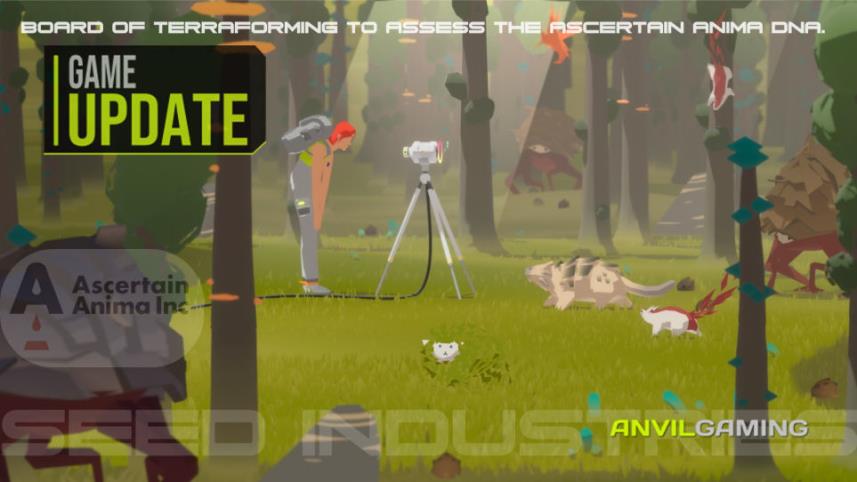
SEED's Dezima Donations event is coming to an end, but the story surrounding it may be far from finished. Spark posts have revealed an Axiom attack, a laboratory breach and DNA reaching Avesta's surface. Now, with a suspicious image showing animals and an unexpected reward teased, we investigate whether Klang has been quietly preparing the planet for new life.
Read More
Klang named its own broken system in public and came back three days later having fixed it four separate ways. The fix list is long enough to finally itemise what trade was costing people. The drone rebalance is the bill, and it charges only those who tidy up.
Read More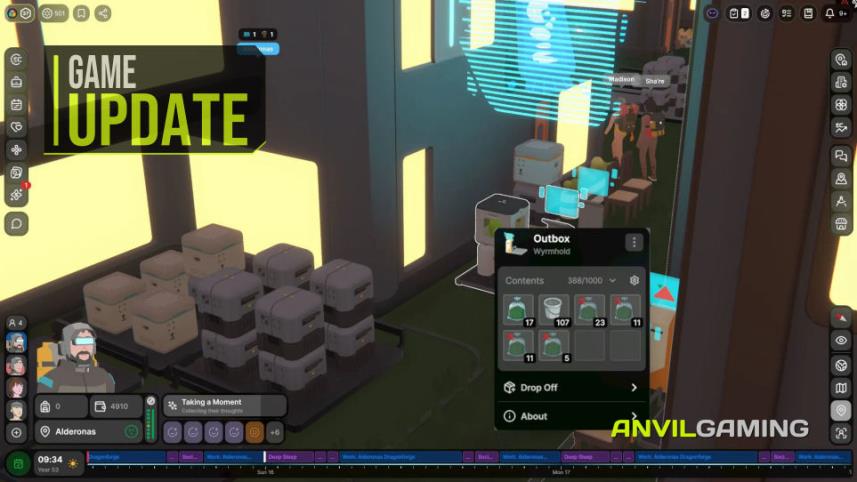
Klang says SEED market failures have fallen from roughly 20% to 4%, but that is not an all-clear. Buyers need free inbox space and scheduled haulers, while responsibility for a lost shipment can change at the Spaceport. Here is who carries the risk now.
Read More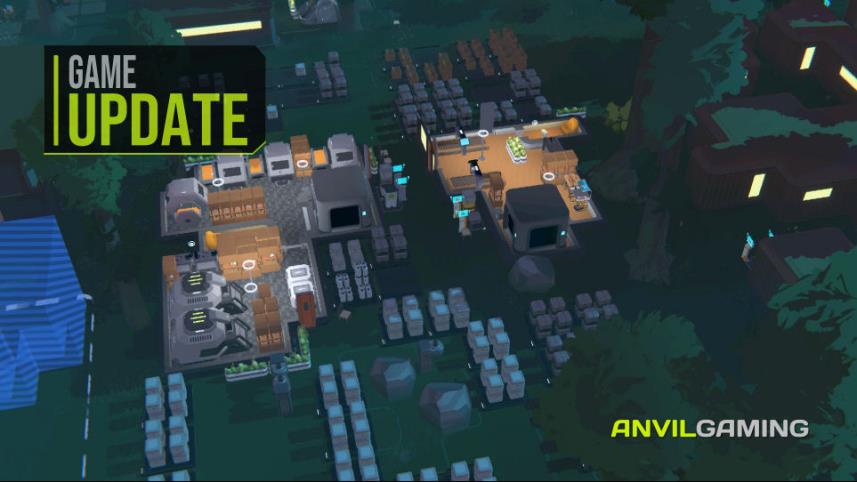
SEED 0.3.4 takes rare ore out of repairs, teaches schedules to explain their failures and stops trees growing back. It also rebalances storage - and because the new capacities only apply to containers you move, tidying up is now the most expensive thing you can do.
Read More
Mundi hosted the Covital Show on SEED's official channel and put the roadmap on screen. 0.4 is City Life - law and order, electricity, organisations, building subdivision, bars. And the board says we are nowhere near the end of it.
Read More
SEED 0.3.3 caps a single Cultivator's votes at 15% of the society population, puts a price on firing a Seedling, and spends the rest of a very long changelog teaching the game to explain its own failures.
Read More
Your Seedling isn't lazy - it's following orders. Every event in SEED's Scheduler has its own priority list, and anything past the top few is wallpaper. How events work, why needs deserve their own hour, when a direct order beats the schedule, and a week you can copy.
Read More
A SEED hospital can have a skilled doctor, medicine on hand, and opening hours, yet still collect one-star 'wasted visit' reviews. This guide turns seven weeks of community troubleshooting into one current setup for services, staffing, stock access, and patient schedules.
Read More
Every crafting task in SEED shows three times, and most players read the wrong one. Total Time only says when the output appears - Work Time is what the job actually costs your settlement. Read them that way and the obvious recipe is often the expensive one.
Read More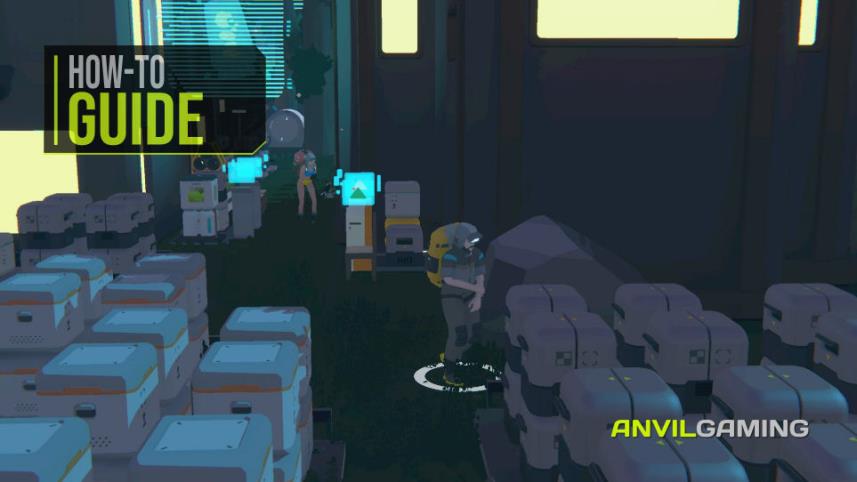
Health in SEED is not a bar you refill. It is a system of specific conditions, severity tiers and sixteen medical specialisms — and the serious end of it depends on other people.
Read More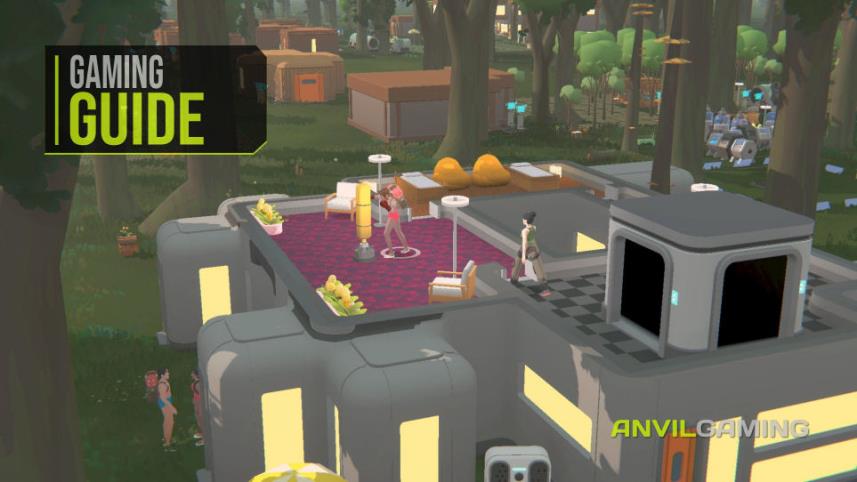
What a Seedling does while you are away in SEED — what keeps running, what it decides for itself, what degrades and how fast, and how to end a session so you come back to a life rather than a mess.
Read More
SEED puts you in charge of people who make their own decisions, on a planet that keeps running whether or not you are logged in. One real hour is one day on Avesta. Here is what that actually means to play, what Early Access still gets wrong, and who should not buy it.
Read More
Wyrmhold does not run open recruitment. We take people for a need, after a conversation. This is what the Hold expects of a resident, what it provides in return, who it is honestly not for, and where to come and talk to us.
Read More
Wyrmhold is our society on Avesta. Its founding stories are not decoration - each one encodes a SEED system that will decide whether your own society survives. Here are three of them, and what they are really about.
Read More
The first record of what Wyrmhold actually did. One month, almost no visible expansion, and a great deal of infrastructure - the survey, the Kernel, the Dragonforge Ward workshops, the Elderwyrm department, an election, and the Hold's first registered business.
Read More