
GAMING
Loading





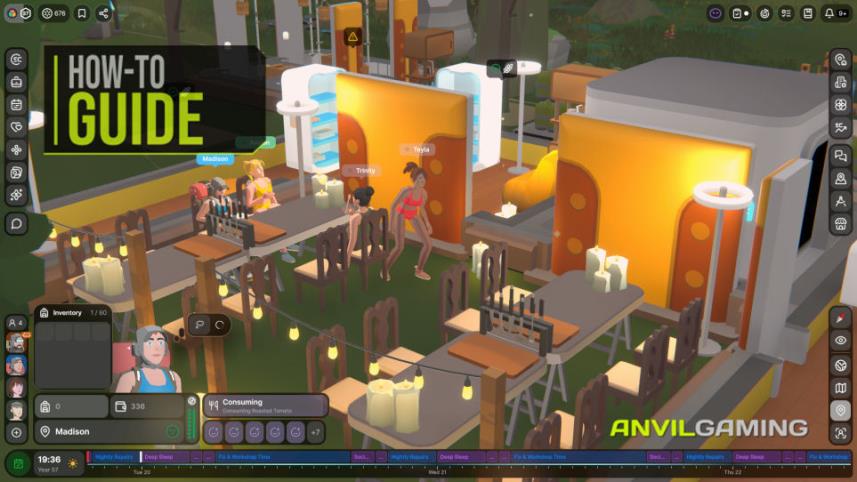
Most failed schedules in SEED fail for one reason, and it isn't laziness. Your Seedling is doing exactly what you told it to. That's the problem.
Every event in the Scheduler carries its own priorities, and a priority list is a pecking order, not a shopping list. It doesn't tell your Seedling to do everything on it - it tells it what to pick first whenever it chooses what to do next. Put twenty into one event and your Seedling works the top few while the rest gather dust. Give each event four, give the needs events of their own, and it gets through the week like a professional.
Get that right and the Scheduler stops being fiddly and becomes the most powerful thing you own. It's also the only one that didn't cost you a single ingot.
Written in September 2026 against SEED 0.3.4, and checked against every set of patch notes from 0.3.0 to 0.3.5 - the Scheduler has been touched in all six. Version 0.4, City Life, is announced but not shipped.
If you haven't opened the Scheduler yet, start with our guide to your first hours on Avesta. This one picks up where that leaves off, and assumes your Seedling has survived its first breakfast.
If you've ever used a work calendar, you already know most of this screen. The difference is that every event on this one is supposed to get something done.
Open the Scheduler, and you get the week across the top, the selected day down the side, a Save as Preset button above it, and tabs for the Calendar, Invitations, and Presets. The header tells you whether the schedule is enabled, and the timeline along the bottom of the screen shows what's coming up.
Everything on that calendar is an event, and opening one shows the four things it decides.
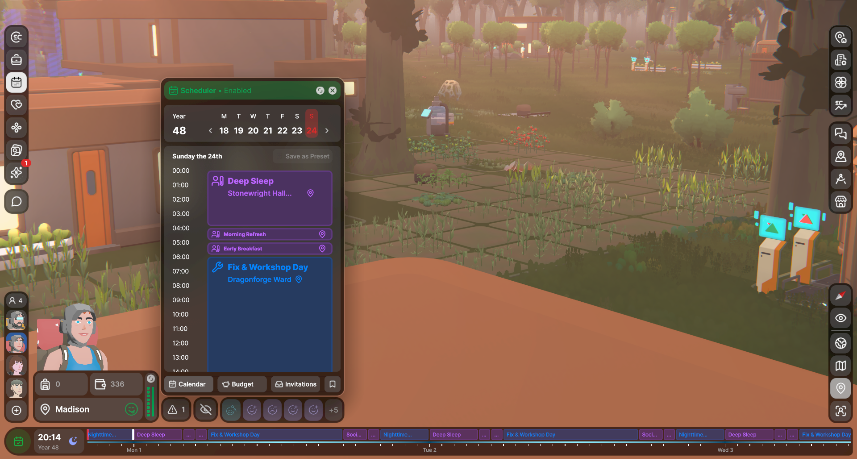
That last point is the one people miss. There is no single master priority list. Each event has its own, and since 0.3.0 a Seedling rethinks what it's doing when a new event with different priorities begins, instead of carrying an old job on for hours as if it never heard the whistle. Events are the skeleton. Their lists are the judgement.
The place matters more than it looks, and it's where 0.3.1 did its best work. An event set on a plot treats the plot and every building on it as one workspace: your Seedling farms outside, runs the machines inside and hauls between the two without separate instructions. Its hauling also stays on that plot, instead of wandering across the settlement with an armful of your goods and no visible plan. That's the change that makes a short schedule possible at all - one event, one place, a whole production chain.
A job is the exception. The shift shows on your Seedling's timeline, but the priorities during it belong to the job role, set by whoever runs the business. On company time, you're not the boss.
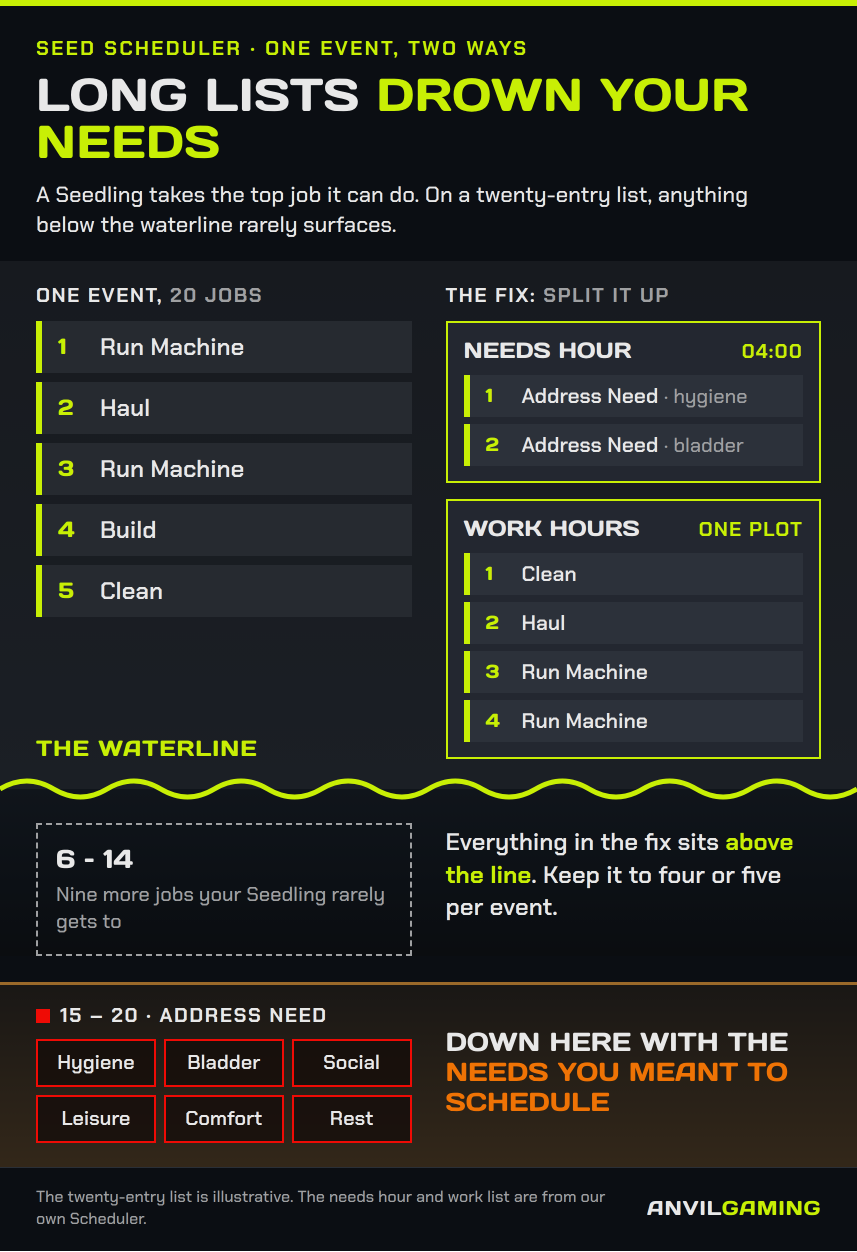
Not for the reason you'd expect. In my play, a Seedling isn't indecisive - within an event, it finishes what it starts, then looks at the list again and takes the highest-ranked thing it can do.
That's exactly the problem. The bottom of a long list never comes up at all. With twenty entries, there's nearly always something doable in the top five, so entries twelve through twenty aren't low priority. They're wallpaper.
And the worst thing to wallpaper over is the Seedling itself. There are nine needs - energy, rest, food, water, bladder, social, leisure, hygiene and comfort - and an Address Need entry at number fifteen of a work event is a promise to shower right after everything else is done, which is to say, never.
Only food and water can kill, and even then SEED gives your Seedling a collapse first, with 24 real hours for anyone who reaches it to try to revive it. The other seven won't kill it. They just grind it down until it stops listening to you.
Then comes the part that makes it visible. A Seedling whose stats fall far enough, or whose energy runs out, stops following the schedule at all and looks after itself instead. That isn't a bug, and it isn't the Seedling being difficult. It's a sick day, and you signed the note.
So the real failure of a twenty-entry event isn't a busy Seedling achieving nothing. It's a Seedling that works diligently through your top five, quietly falls apart, and then ignores you completely.
Four or five is the working number. The discipline isn't "keep it short" for its own sake - it's that you should be able to name what a new priority displaces before you add it. If you can't, you haven't written a ranking. You've written a wish.

This is where the calendar earns its keep. Instead of burying upkeep at the bottom of a work list, give it an hour of its own, at the top of a list with nothing else to compete with.
My own days open that way. Sleep runs from midnight to 04:00. Then comes a one-hour event whose whole list is Address Need - hygiene first, bladder second, and I'll leave you to judge how brave that order is - followed by an hour for breakfast, before the work event starts at 06:00. By the time the work list takes over, the needs have already had their turn, so the work event can be all work.
Each Address Need entry also carries its own percentage slider. Mine sits at 70% for hygiene, and the question mark beside it explains the setting in the client. Read it before copying anyone's number, mine included.
Company can be booked the same way. Because an event can invite other Seedlings, time with friends can be an appointment on both calendars rather than something you hope happens. Friendship on Avesta, it turns out, runs on calendar invites.
The Scheduler plans the week. For a one-off, use a direct order: pick the job from the in-game UI and tell your Seedling to do it. Think of it as a tap on the shoulder. It won't drop what it's holding - it finishes the task it's on, then takes your order ahead of whatever the schedule had lined up next.
That makes a direct order the right tool for the exception and the wrong one for the routine. If you're giving the same order every morning, you aren't directing a Seedling. You're doing its schedule by hand. Put it in an event.
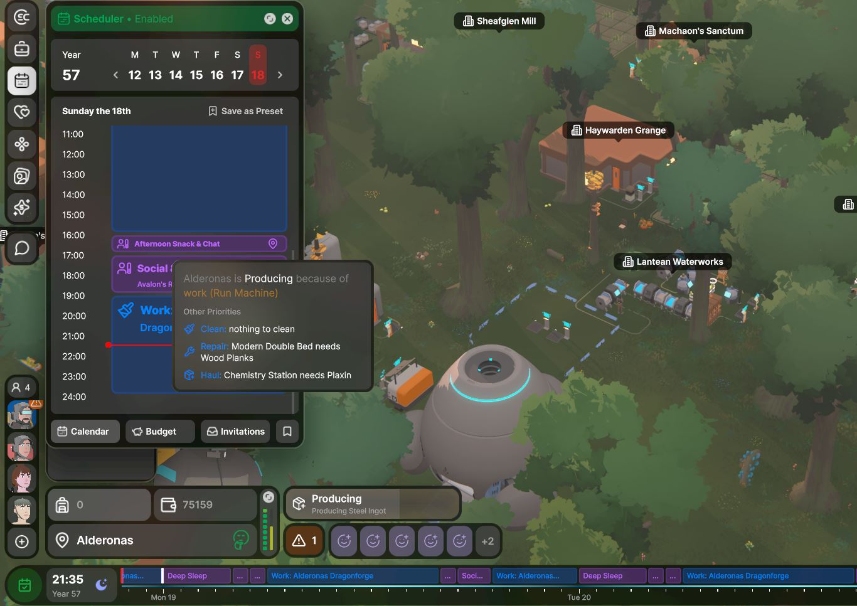
Since 0.3.4 the Scheduler tells on your events, and it's the most useful thing Klang has added to it since plots became locations. An event that can't do any of its priorities now carries a badge - yellow when the Seedling found something else to do, red when it needs you - and hovering over it lists each priority with the reason it isn't happening, in plain words such as "no Pumpkin fields". Hard to argue with that. A priority that silently found nothing used to look exactly like one that worked. Now it doesn't, and Klang was right to make that the Scheduler's job rather than yours.
Know what it's watching, though. The badge appears when nothing in an event can run. An event whose top entry keeps your Seedling busy all day looks perfectly healthy while entry twelve starves underneath it. The badge is a smoke alarm. It'll tell you the kitchen is on fire. It won't tell you you're out of milk - the starved entry is still yours to spot.
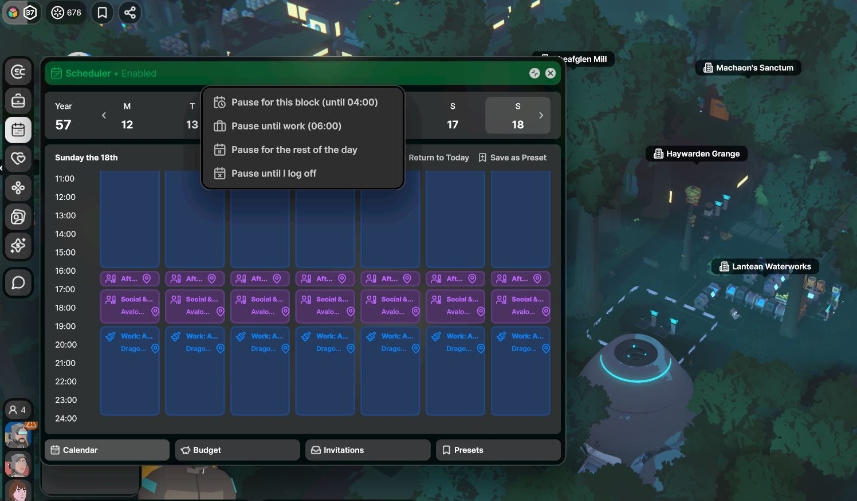
A single week can't serve a build week, a quiet week, and a week you're away. The Scheduler assumes as much, even if you don't.
Four housekeeping notes, because each of them has ambushed somebody. Since 0.3.2 the Consume and Serve priorities cover only actual food and drink, and anything else that was sitting in them was removed from existing schedules automatically. The old Deliver priority no longer exists - 0.3.1 folded it into Haul, which now also covers self-pickup deliveries. Client Deliveries is a job-role priority for Seedlings working in logistics, not one for your own events. And the Budget tab you'll see in older screenshots moved to the Wallet in 0.3.5, which is at least where you'd go looking for money.

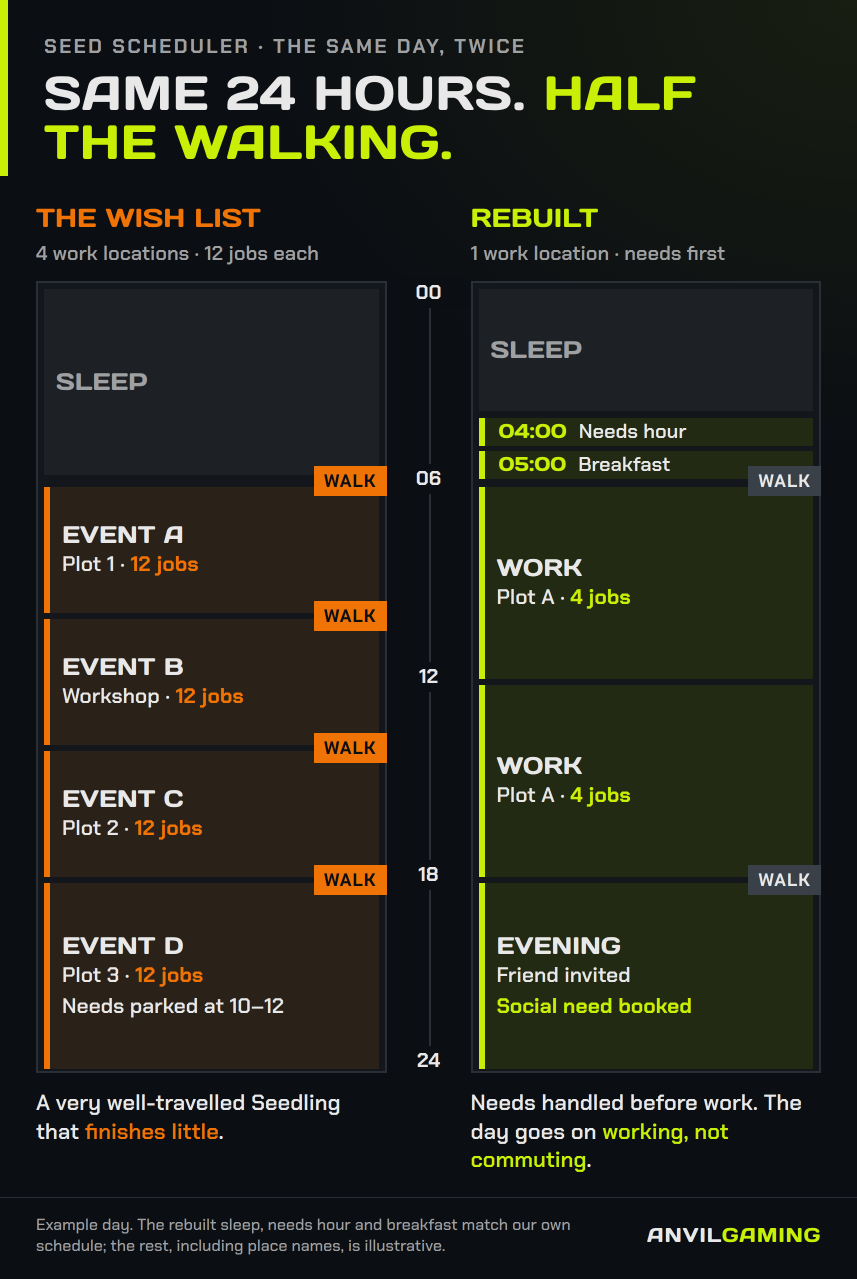
Here's the shape a lot of first schedules take. You may recognise it. No judgement.
The wish list. Events strung across the whole waking day, each at a different location, and the same twelve priorities in every one of them - farm, haul, cook, craft, repair, build, clean, trade, forage and so on - with a few Address Need entries tacked on at the bottom so the needs are "covered".
It fails predictably. Every change of event sends the Seedling on a cross-country hike, so a good part of its day goes on walking. It finishes little, the Address Need entries at ten, eleven and twelve do about as much as a sticky note on the fridge, and eventually you have a Seedling that has stopped listening.
The same week, rebuilt.
The rebuilt week has more events and far shorter lists, and it does considerably more. If you take one thing from this guide, take the habit of asking what a priority displaces. Your Seedling will never thank you for it. Its hygiene will.











SEED puts you in charge of people who make their own decisions, on a planet that keeps running whether or not you are logged in. One real hour is one day on Avesta. Here is what that actually means to play, what Early Access still gets wrong, and who should not buy it.
Read More
A SEED hospital can have a skilled doctor, medicine on hand, and opening hours, yet still collect one-star 'wasted visit' reviews. This guide turns seven weeks of community troubleshooting into one current setup for services, staffing, stock access, and patient schedules.
Read More
Every crafting task in SEED shows three times, and most players read the wrong one. Total Time only says when the output appears - Work Time is what the job actually costs your settlement. Read them that way and the obvious recipe is often the expensive one.
Read More
Health in SEED is not a bar you refill. It is a system of specific conditions, severity tiers and sixteen medical specialisms — and the serious end of it depends on other people.
Read More
An onboarding guide to a new player's first hours in SEED on Avesta: what a Seedling actually is, the survival mistakes that cost a day, why the Scheduler matters more than anything you build, and what to ignore until later.
Read More
What a Seedling does while you are away in SEED — what keeps running, what it decides for itself, what degrades and how fast, and how to end a session so you come back to a life rather than a mess.
Read More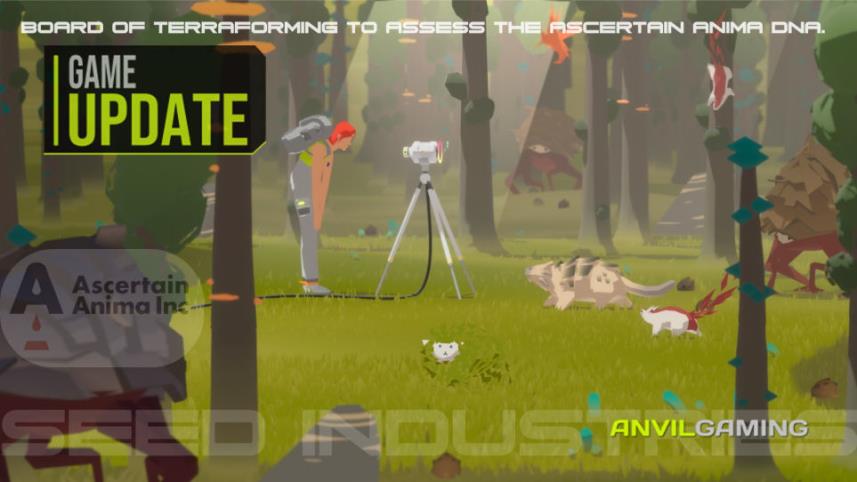
SEED's Dezima Donations event is coming to an end, but the story surrounding it may be far from finished. Spark posts have revealed an Axiom attack, a laboratory breach and DNA reaching Avesta's surface. Now, with a suspicious image showing animals and an unexpected reward teased, we investigate whether Klang has been quietly preparing the planet for new life.
Read More
Klang named its own broken system in public and came back three days later having fixed it four separate ways. The fix list is long enough to finally itemise what trade was costing people. The drone rebalance is the bill, and it charges only those who tidy up.
Read More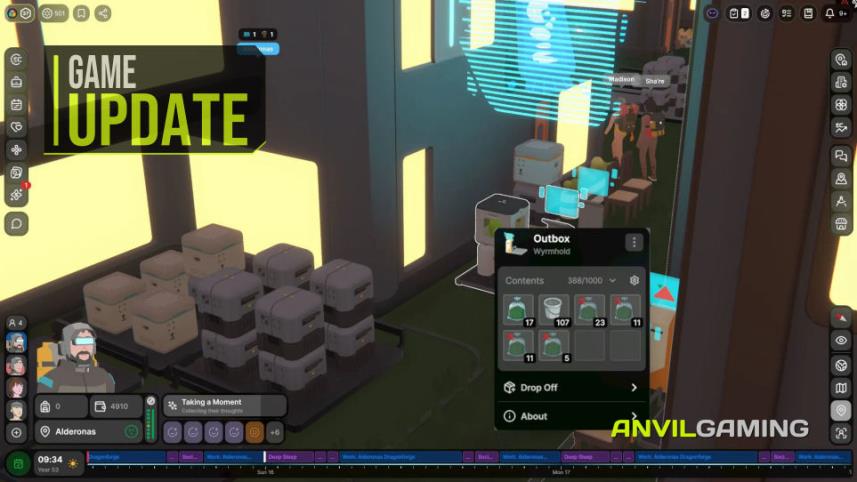
Klang says SEED market failures have fallen from roughly 20% to 4%, but that is not an all-clear. Buyers need free inbox space and scheduled haulers, while responsibility for a lost shipment can change at the Spaceport. Here is who carries the risk now.
Read More
SEED 0.3.4 takes rare ore out of repairs, teaches schedules to explain their failures and stops trees growing back. It also rebalances storage - and because the new capacities only apply to containers you move, tidying up is now the most expensive thing you can do.
Read More
Mundi hosted the Covital Show on SEED's official channel and put the roadmap on screen. 0.4 is City Life - law and order, electricity, organisations, building subdivision, bars. And the board says we are nowhere near the end of it.
Read More
SEED 0.3.3 caps a single Cultivator's votes at 15% of the society population, puts a price on firing a Seedling, and spends the rest of a very long changelog teaching the game to explain its own failures.
Read More
Wyrmhold does not run open recruitment. We take people for a need, after a conversation. This is what the Hold expects of a resident, what it provides in return, who it is honestly not for, and where to come and talk to us.
Read More
Wyrmhold is our society on Avesta. Its founding stories are not decoration - each one encodes a SEED system that will decide whether your own society survives. Here are three of them, and what they are really about.
Read More
The first record of what Wyrmhold actually did. One month, almost no visible expansion, and a great deal of infrastructure - the survey, the Kernel, the Dragonforge Ward workshops, the Elderwyrm department, an election, and the Hold's first registered business.
Read More