
GAMING
Loading





You can give a SEED hospital a trained doctor, opening hours, and enough medicine to make the shelves rattle, then watch it earn one star because a patient had a "wasted visit". The building is not the hospital. The working chain between its services, staff, stock, and customers is.
The short version is this: advertise only what the building can supply, put Heal at the top of the employee's work, keep the matching remedies accessible, and make sure the clinic is staffed while it is open. If any one of those conditions fails, the front door can remain open while the service behind it effectively disappears.
This guide began with the hospital discussion in SEED's official How to Play Discord channel. The thread started on 23 July, before SEED 0.3.1 changed several health and service behaviours, and continued into September. Player reports are useful field notes, not patch notes, so every rule below has been checked against the current 0.3.4 build information and the game's own data.
The game's treatment chain is unusually literal.
That is four separate handshakes. A clinic can look complete while failing any one of them.
SEED 0.3.4 made the patient side easier to read. A Seedling with Seek Treatment should only travel when it has a matching treatable ailment and the clinic has the needed remedy. If it cannot, the Scheduler can now say "no [Ailment] to treat" or "no [Ailment] remedy available". Those messages are not decorative. They tell you whether the chain broke before the patient even reached the door.
The owner still has work to do at the other end.

The Discord thread began with what sounded like a complete setup: First Aid and Pharmacy at level 10, medicine in storage and a worker told to heal. The clinic was still collecting one-star reviews. The first useful question was not about skill. It was whether the right services had actually been advertised.
Start with Suggest Services. Since 0.3.1, it shows the changes it wants to make and lets you accept or reject them individually. Use it as a diagnostic tool, then keep only the services you intend to support.
Do not leave an old healing service advertised after its remedy runs out. In 0.3.1, Klang changed employees so they would no longer take an order or diagnose a customer when the required resources were missing from the building. That is sensible behaviour for the employee and a miserable visit for the person who crossed a settlement to get there.
This is the first rule of the clinic: if it appears in Advertised Services, stock it as though somebody is already walking towards you.
The thread spent a great deal of time circling First Aid level 20. That level matters, but not in the way the one-star reviews make it feel.
First Aid 20 unlocks twelve specialist branches, including Wound Care, Burn Care, Fracture Care, Infectiology, Traumatology and the organ-specific disciplines. Those skills increase the chance that a treatment succeeds and reduce its duration by 2.5% per level. A Seedling's confidence also affects whether it will attempt difficult treatment autonomously; Direct Control can force an attempt when confidence is the thing stopping it.
What level 20 does not do is switch healing from impossible to possible. The remedy data gives each treatment a difficulty and a specialist skill that improves the roll. It does not impose a blanket level gate on administering care.
That distinction explains two reports that otherwise appear to disagree. A player can truthfully say that healing works below level 20, while another watches a doctor decline a treatment with roughly even odds. The first has found the absence of a hard gate. The second has found the confidence system.
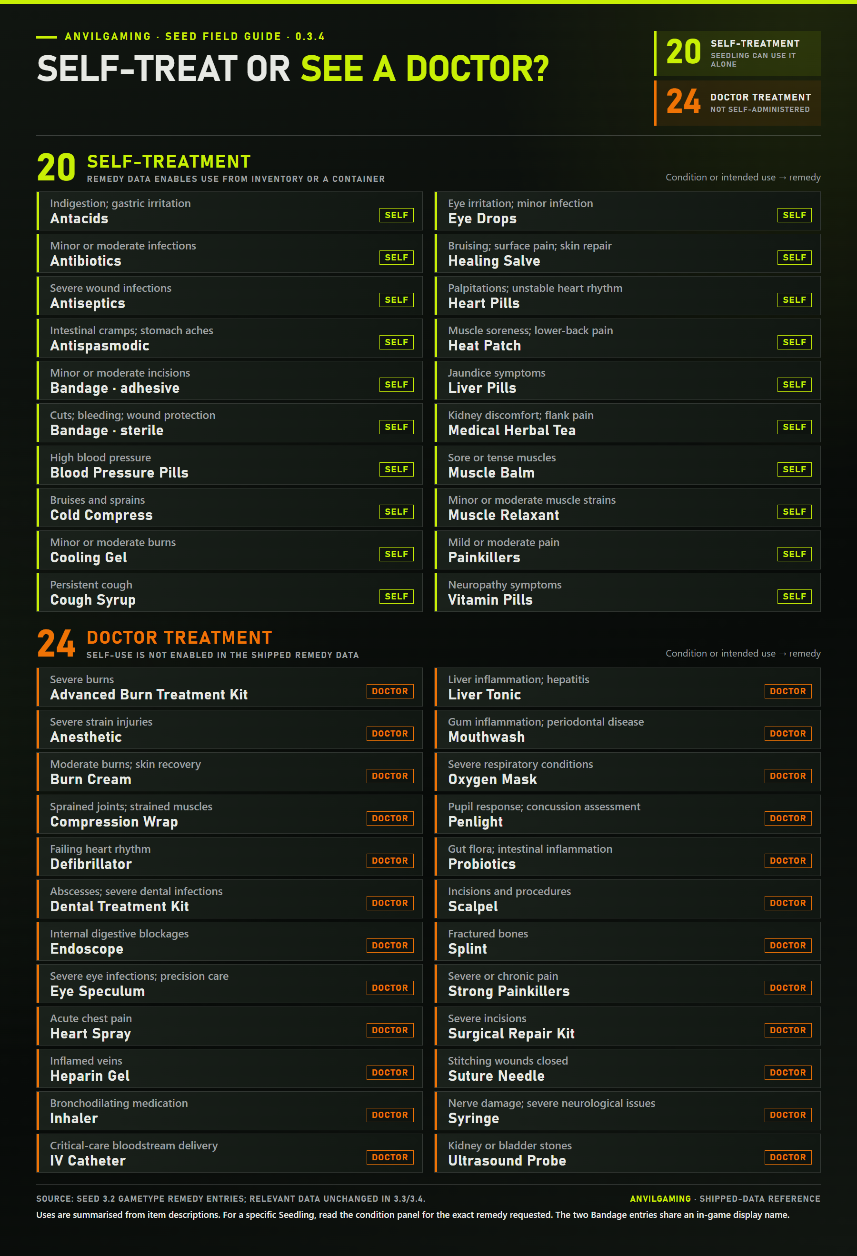
Before blaming the doctor, open the patient's condition panel and read the named remedy. Then check that exact item - not "some medicine" - is inside the clinic and accessible to the employee. Our full illness and injury guide explains the severity tiers and the split between self-treatment and doctor-administered remedies.

Medicine access caused the thread's messiest argument because both answers can work, and each creates a different problem.
Put medicine in a public room and visiting Seedlings may be able to take self-administered remedies straight from the container. That can make the building useful as an open medicine cupboard, but this is stock access rather than a paid pharmacy service. Owners in the thread reported supplies disappearing before a doctor could use them, with no evidence that the clinic was paid for those items.
Put everything in a private room and visitors cannot help themselves. The employee still needs access, and the service panel must remain free of resource or access warnings. If the building can no longer see what it needs for an advertised activity, privacy has protected the stock by making the service impossible. Excellent security. Terrible medicine.
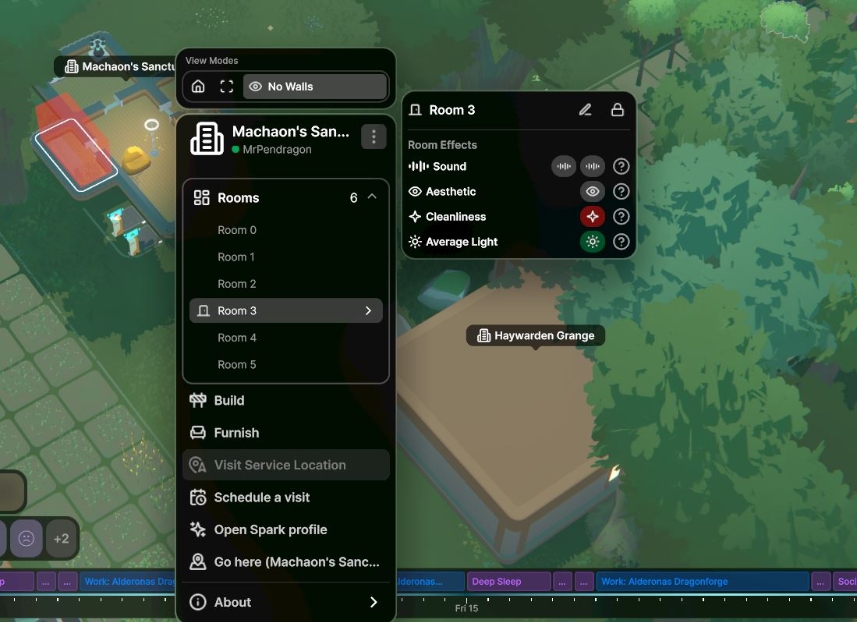
The cleanest community workaround is a two-zone clinic:
That layout is a recommendation, not a documented universal rule. Room access and service detection have changed before. After moving a container or changing a room to private, reopen Advertised Services, inspect every warning and test the route with one inexpensive remedy.
One of the most useful late observations in the Discord thread came after the major 0.3.1 fixes. A clinic owner watched an injured visitor arrive while both employees were producing chemicals. The patient left before either worker became free, and a negative review appeared.
That is one player's observation, not a published rule for the review system. It is still a very good reason to keep one clinician available during opening hours.

Put Heal first in the employee's job role and work schedule. Make the work block overlap the clinic's opening hours. If the same Seedling also manufactures remedies, hauls materials and produces chemicals, schedule those jobs outside the service window or give them to somebody else. Lower priorities are useful only when they do not occupy the person your customers came to see.
This is where a hospital becomes expensive. Idle capacity looks wasteful until the minute it is needed. A fire brigade has the same accounting problem.
SEED's star rating does not currently explain the whole service failure, but the text attached to it can narrow the search.
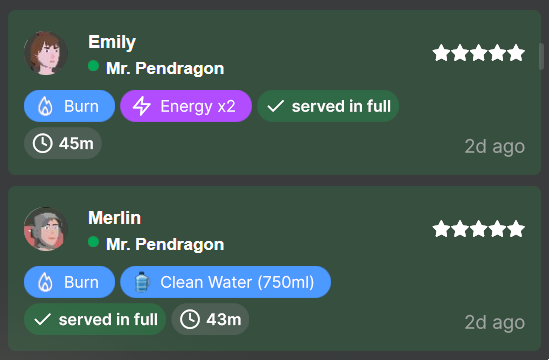
Check whether the promised service was still advertised, the matching remedy was present, and an employee was free to Heal at the time of arrival. Community reports repeatedly connect "wasted visit" reviews with a service that could be entered but not completed.
Confirm that an eligible patient exists, that the patient is actually seeking treatment, and that the employee's work includes Heal. Minor or moderate conditions may be self-treated, so an idle doctor is not proof that the clinic is broken.
Read the new 0.3.4 reason before changing anything. "No ailment to treat" means the Seedling does not currently need that trip. "No remedy available" sends you back to the condition panel, clinic stock, and Advertised Services.
Check whether the container sits in a public room and whether the item is self-administered. Move controlled stock behind staff access, then recheck the service warnings. Do not solve a stock leak by silently breaking the advertised treatment.
Give the clinic a service-only window and watch it for a cycle. If ratings recover, staff availability was the variable. If they do not, you have eliminated one cause without rebuilding the premises.
SEED does not currently let a clinic owner price each treatment separately. As of 0.3.4, the owner chooses one flat price for the advertised healing service, regardless of the ailment or remedy involved. Charging different amounts for different treatments is a requested feature, not a current one.
Set the entry fee to zero until the service chain works consistently. It removes one variable, avoids charging visitors at the door, and leaves only the flat healing-service price to test. SEED 0.3.4 now refunds an entry fee when check-in fails, or the visitor never arrives inside the 30 in-game-minute window, but a refund is not a cure for a hospital that cannot complete the visit.

One boundary matters here. SEED 0.3.1 confirms that doctors can charge for a paid advertised healing service, but that is not the same as selling the remedy itself over the counter. The shipped data separates ordinary consumable orders from diagnosis, remedy collection, and treatment. Medicine used by the doctor is an input to that flat-priced service, not a separately priced item. If you want to sell remedies themselves, the market is the current route.
That boundary matters to the economics. Players in the discussion describe treatment demand as intermittent and report earning more from remedies sold on the market, chemical production, or ordinary food and drink services than from patients walking in. That does not prove hospitals cannot make money. It does mean a doctor waiting all day for one severe condition is a poor production plan.
Run the clinic as healthcare first. Let medicine production and market sales support it. Do not fill every quiet minute with another job and then act surprised when the doctor is busy.
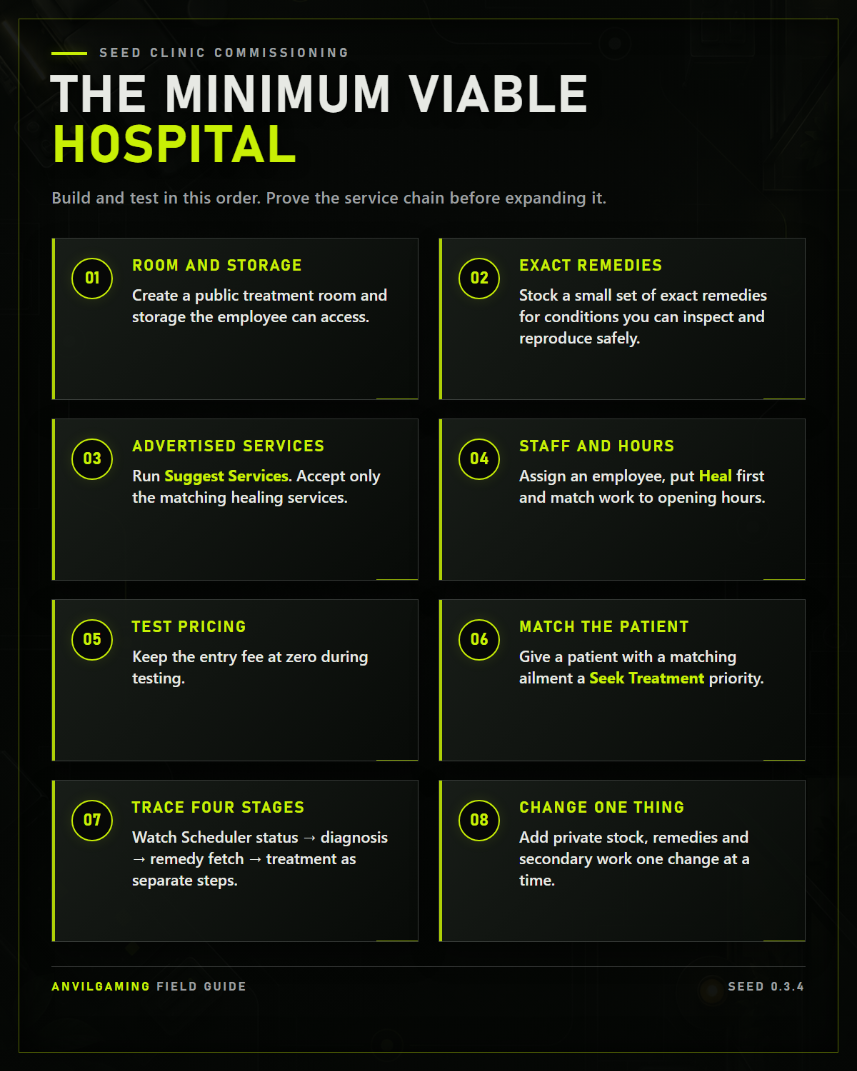
That last point matters. The Discord thread became difficult to untangle because owners changed services, room privacy, schedules, stock, and prices together. When the clinic improved, nobody could always say which change fixed it.
A hospital is one of SEED's best systems precisely because it refuses to be a magic room. It is also capable of giving you one star for failing a contract you did not realise you had made. Configure the promise first. Decorate the waiting room later.







With Stormforce Gaming you can design your own custom gaming PC which they will then build for you!





An onboarding guide to a new player's first hours in SEED on Avesta: what a Seedling actually is, the survival mistakes that cost a day, why the Scheduler matters more than anything you build, and what to ignore until later.
Read More
Health in SEED is not a bar you refill. It is a system of specific conditions, severity tiers and sixteen medical specialisms — and the serious end of it depends on other people.
Read More
SEED puts you in charge of people who make their own decisions, on a planet that keeps running whether or not you are logged in. One real hour is one day on Avesta. Here is what that actually means to play, what Early Access still gets wrong, and who should not buy it.
Read More
Every crafting task in SEED shows three times, and most players read the wrong one. Total Time only says when the output appears - Work Time is what the job actually costs your settlement. Read them that way and the obvious recipe is often the expensive one.
Read More
Your Seedling isn't lazy - it's following orders. Every event in SEED's Scheduler has its own priority list, and anything past the top few is wallpaper. How events work, why needs deserve their own hour, when a direct order beats the schedule, and a week you can copy.
Read More
What a Seedling does while you are away in SEED — what keeps running, what it decides for itself, what degrades and how fast, and how to end a session so you come back to a life rather than a mess.
Read More
SEED's Dezima Donations event is coming to an end, but the story surrounding it may be far from finished. Spark posts have revealed an Axiom attack, a laboratory breach and DNA reaching Avesta's surface. Now, with a suspicious image showing animals and an unexpected reward teased, we investigate whether Klang has been quietly preparing the planet for new life.
Read More
Klang named its own broken system in public and came back three days later having fixed it four separate ways. The fix list is long enough to finally itemise what trade was costing people. The drone rebalance is the bill, and it charges only those who tidy up.
Read More
Klang says SEED market failures have fallen from roughly 20% to 4%, but that is not an all-clear. Buyers need free inbox space and scheduled haulers, while responsibility for a lost shipment can change at the Spaceport. Here is who carries the risk now.
Read More
SEED 0.3.4 takes rare ore out of repairs, teaches schedules to explain their failures and stops trees growing back. It also rebalances storage - and because the new capacities only apply to containers you move, tidying up is now the most expensive thing you can do.
Read More
Mundi hosted the Covital Show on SEED's official channel and put the roadmap on screen. 0.4 is City Life - law and order, electricity, organisations, building subdivision, bars. And the board says we are nowhere near the end of it.
Read More
SEED 0.3.3 caps a single Cultivator's votes at 15% of the society population, puts a price on firing a Seedling, and spends the rest of a very long changelog teaching the game to explain its own failures.
Read More
Wyrmhold does not run open recruitment. We take people for a need, after a conversation. This is what the Hold expects of a resident, what it provides in return, who it is honestly not for, and where to come and talk to us.
Read More
Wyrmhold is our society on Avesta. Its founding stories are not decoration - each one encodes a SEED system that will decide whether your own society survives. Here are three of them, and what they are really about.
Read More
The first record of what Wyrmhold actually did. One month, almost no visible expansion, and a great deal of infrastructure - the survey, the Kernel, the Dragonforge Ward workshops, the Elderwyrm department, an election, and the Hold's first registered business.
Read More