
GAMING
Loading





Most survival games give you a health bar and a bandage. SEED gives you an eye speculum, a defibrillator, and sixteen medical specialisms - and then, unusually, it tells you exactly which one you need.
That is worth saying plainly at the top, because it is the opposite of what the depth suggests. The moment a Seedling picks up a condition, the game hands you the whole picture: what it is, how bad it is, what caused it, what it is costing you, how likely it is to get worse, and the name of the item that fixes it. You are never guessing.
What you can be short of is the item and the person. Health here is not a resource you top up; it is a service - and the gap between knowing the answer and being able to act on it is the entire subject of this guide.
Written against SEED 0.3.3, September 2026. Ailment and remedy details come from the game's own item data at content release 3.3; sunburn was added as an injury in 0.3.2, and 0.3.3 narrowed fatal-ailment warnings to conditions that are genuinely dangerous.
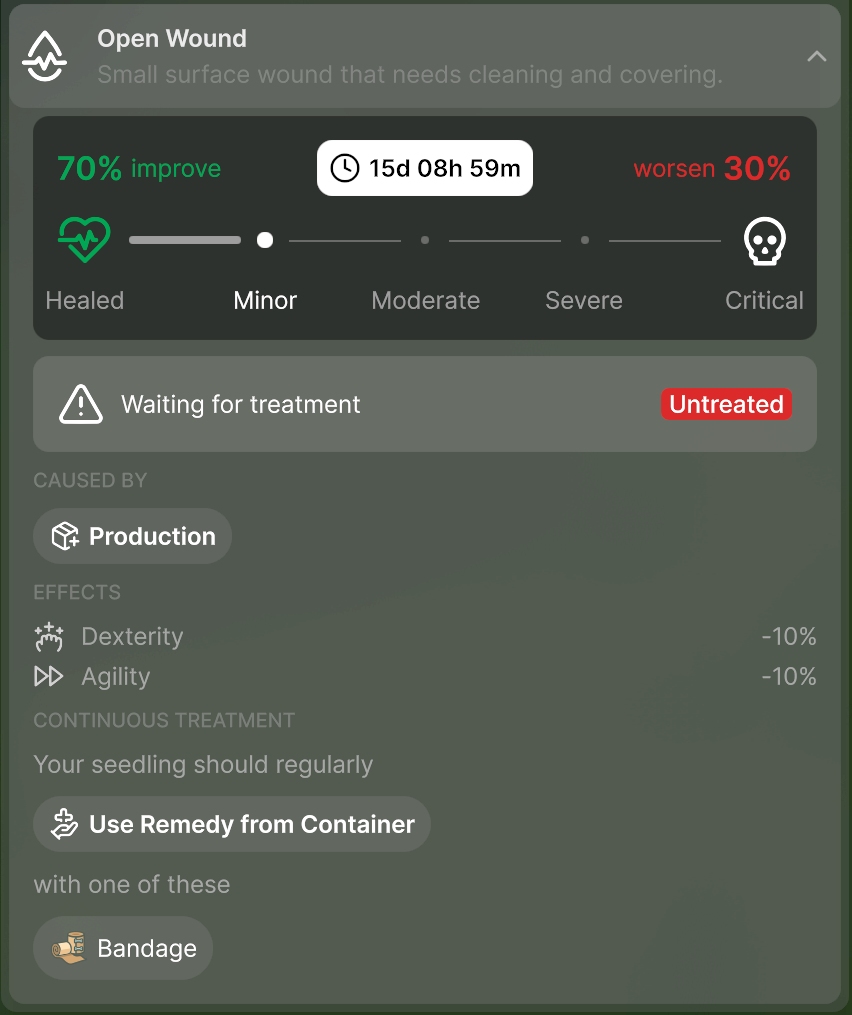
Open a Seedling with a condition, and the panel gives you, in one screen:
Then click the remedy, and the Catalog opens on it: every condition that item treats, how much space it takes, and - if it can be made - the recipe, the machine, the skill level, and a full crafting chain back to raw ore.
So the reflex worth building is not "learn the medical system". It is opening the panel and reading it. The information problem is solved. What is left is a logistics problem, and that is the half you have to solve yourself.
The game distinguishes injuries from illnesses, and both are specific rather than generic. The remedy list is the clearest window onto how far that goes - 44 of them, covering:
Your Seedling can get periodontal disease. There is a mouthwash for it.
The practical consequence of that specificity: the right remedy is narrow. Painkillers do not treat an infection. A cold compress does nothing for a fracture. Stocking "some medicine" is not stocking medicine.
Nearly every condition comes in tiers, and the tier decides the treatment.
That last line is the whole article in miniature, and the item data draws it out across the whole remedy list: twenty of the forty-four remedies are marked as something a Seedling can apply to itself. The other twenty-four are not. Severity does not just change the item. It changes who is allowed to help.
Notice which way the ladder runs. Every rung a Seedling can climb alone is the cheap end - bandages, antibiotics, cooling gel, painkillers. Every rung at the severe end needs hands that are not its own.
This is also why "an illness spirals" is a real mechanic rather than a figure of speech, and the panel shows it as a number. An untreated condition carries a standing chance of worsening - 30% on the minor open wound above - and every step down the scale needs a scarcer remedy and, often, a person you may not have. Treating it is not merely faster healing. It is changing those odds before they are rolled.
Note the shape of the treatment instruction too: your Seedling should regularly use a remedy from a container. Treatment is a repeating schedule entry, not a single click you perform and forget. A remedy sitting in the store with no slot to apply it in is the same as no remedy - which is the Scheduler's problem, not medicine's.

Healthcare in SEED is not one skill. It is a profession tree: first aid, medicine, wound care, burn care, fracture care, infectiology, traumatology, emergency response, pharmacy, physiotherapy, cardiology, dentistry, gastroenterology, nephrology, neurology and ophthalmology.
No Seedling holds all of that. Which means a settlement's medical capability is a real thing with gaps in it, and the gaps are invisible until somebody falls in one.
Treatment is visibly a social act in the game's own terms - a Seedling diagnoses another Seedling's injury, and fetches a remedy from storage to treat them. Two separate steps, and both can fail: nobody qualified to diagnose, or nothing in the store to fetch.
Worth being precise about what the specialisms do, because it is easy to assume worse than the truth. A skill raises the success chance of a treatment; it does not lock you out of attempting one. Every remedy carries its own difficulty rating and one named specialism that improves the odds against it, so an untrained Seedling applying antiseptics is not forbidden - just considerably more likely to make a mess of it. Two stats swing every attempt as well, the same two every time: Intelligence and Intuition.
The difficulty numbers are where this stops being abstract. They run from 7.5 to 25, and they line up almost exactly with the self-administration split: the median difficulty of a remedy a Seedling can apply to itself is 7.5. The median for one that needs somebody else is 20. Everything you can handle alone is easy. Everything you cannot is roughly three times harder, and it is being attempted by whoever happens to be qualified.
Treating someone also trains the specialism involved, which means a settlement's doctor gets better at exactly the things that keep going wrong there.
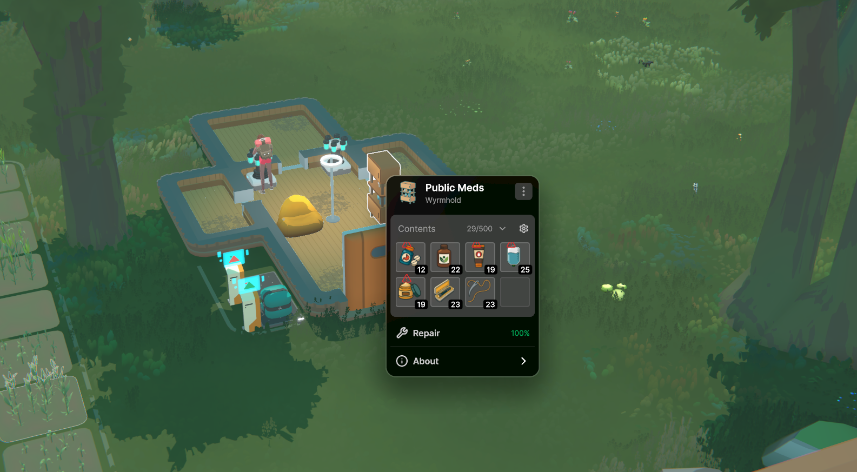
The Kernel arrives stocked with a starter kit, and it is worth knowing exactly what it covers: ten each of bandages, antiseptics, cooling gel, muscle relaxant, healing salve and cold compress, plus three surgical repair kits.
Read that list as a statement of intent. It covers cuts, minor burns, bruises, strains and the severe end of two things - wound infection and deep incisions. It is a trauma kit for people doing physical work in a new settlement, and it is finite.
It also contains the trap. Six of the seven items are self-administrable; the three surgical repair kits are not. The one thing in the box for a genuine emergency is the one thing a Seedling on its own cannot use.
It contains nothing for hearts, lungs, kidneys, teeth, eyes or nerves.
Every one of the 44 remedies has a recipe, and they all run on the same machine - the Medical Fabricator. The gate is lower than the equipment implies. An IV Catheter, which treats seven of the worst things in the game, including three kinds of sepsis, needs Pharmacy level zero: two Glass and ten Iron Rod, fifteen minutes, and it comes out twenty-four at a time.
Two things follow from that, and they point in opposite directions.
The encouraging one: a settlement's medical store is a production problem, not a luck problem. Nothing here is gated behind rare drops or deep tech. If you are short of something, somebody can make it, and the Catalog will show you the chain back to raw ore.
The other one: none of the 45 Medical Fabricator recipes can be automated. Not one. Medicine is hand-made in SEED, every time, by a Seedling standing at the machine - which means a medical store does not restock itself while you are away. It restocks when somebody's schedule says so.
Remedies also age. The Catalog lists a lifespan on the item's own page and what it decays into when it expires - biomass, in the end. A store stocked once and forgotten is not a store.
Everything above depends on other people. This part does not, which makes it the highest-value habit in the early game.

None of this needs a doctor, a stocked store, or a settlement. It only needs the tasks to exist and a schedule slot to do them in.
Here is the turn, and it is worth being direct about it.
After several hundred words about remedies, the useful conclusion is not "stockpile medicine". It is that the serious half of staying alive in SEED is something a settlement does for you, not something you do for yourself.
Look again at what the condition panel actually withholds. Nothing. It names the remedy. What it cannot tell you is whether that remedy is in the store, whether anyone within reach has the specialism to apply it, or whether your Seedling has a schedule slot free to receive it. Three logistics questions, and the game leaves every one of them to the settlement.
That is difficult to arrange for a Seedling living alone, and largely solved by joining somewhere that has already arranged it. It is also the least visible reason a new player is better off arriving in an established society than founding one: not the shelter or the food supply, but the fact that when something goes badly wrong there is a person and a cupboard.
Worth asking, before you commit a Seedling anywhere: who here is the doctor, and what is in the store?










A SEED hospital can have a skilled doctor, medicine on hand, and opening hours, yet still collect one-star 'wasted visit' reviews. This guide turns seven weeks of community troubleshooting into one current setup for services, staffing, stock access, and patient schedules.
Read More
SEED puts you in charge of people who make their own decisions, on a planet that keeps running whether or not you are logged in. One real hour is one day on Avesta. Here is what that actually means to play, what Early Access still gets wrong, and who should not buy it.
Read More
What a Seedling does while you are away in SEED — what keeps running, what it decides for itself, what degrades and how fast, and how to end a session so you come back to a life rather than a mess.
Read More
Every crafting task in SEED shows three times, and most players read the wrong one. Total Time only says when the output appears - Work Time is what the job actually costs your settlement. Read them that way and the obvious recipe is often the expensive one.
Read More
An onboarding guide to a new player's first hours in SEED on Avesta: what a Seedling actually is, the survival mistakes that cost a day, why the Scheduler matters more than anything you build, and what to ignore until later.
Read More
Your Seedling isn't lazy - it's following orders. Every event in SEED's Scheduler has its own priority list, and anything past the top few is wallpaper. How events work, why needs deserve their own hour, when a direct order beats the schedule, and a week you can copy.
Read More
SEED's Dezima Donations event is coming to an end, but the story surrounding it may be far from finished. Spark posts have revealed an Axiom attack, a laboratory breach and DNA reaching Avesta's surface. Now, with a suspicious image showing animals and an unexpected reward teased, we investigate whether Klang has been quietly preparing the planet for new life.
Read More
Klang named its own broken system in public and came back three days later having fixed it four separate ways. The fix list is long enough to finally itemise what trade was costing people. The drone rebalance is the bill, and it charges only those who tidy up.
Read More
Klang says SEED market failures have fallen from roughly 20% to 4%, but that is not an all-clear. Buyers need free inbox space and scheduled haulers, while responsibility for a lost shipment can change at the Spaceport. Here is who carries the risk now.
Read More
SEED 0.3.4 takes rare ore out of repairs, teaches schedules to explain their failures and stops trees growing back. It also rebalances storage - and because the new capacities only apply to containers you move, tidying up is now the most expensive thing you can do.
Read More
Mundi hosted the Covital Show on SEED's official channel and put the roadmap on screen. 0.4 is City Life - law and order, electricity, organisations, building subdivision, bars. And the board says we are nowhere near the end of it.
Read More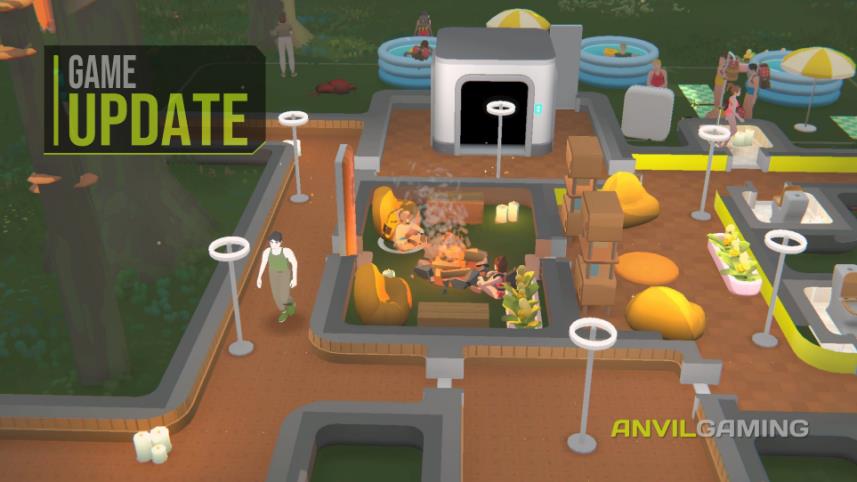
SEED 0.3.3 caps a single Cultivator's votes at 15% of the society population, puts a price on firing a Seedling, and spends the rest of a very long changelog teaching the game to explain its own failures.
Read More
Wyrmhold does not run open recruitment. We take people for a need, after a conversation. This is what the Hold expects of a resident, what it provides in return, who it is honestly not for, and where to come and talk to us.
Read More
Wyrmhold is our society on Avesta. Its founding stories are not decoration - each one encodes a SEED system that will decide whether your own society survives. Here are three of them, and what they are really about.
Read More
The first record of what Wyrmhold actually did. One month, almost no visible expansion, and a great deal of infrastructure - the survey, the Kernel, the Dragonforge Ward workshops, the Elderwyrm department, an election, and the Hold's first registered business.
Read More